Back to blog
How do I compare two builders’ quotes fairly?
Many people just go with their gut: pick a quote in the middle and hope for the best. We all do it. But a renovation is a big investment, you need all the facts to make a smart and informed decision – not one based on incomplete or misleading information.

George Harris
April 24, 2025
You can’t compare two builders’ quotes fairly until both of them price the same work. So the first job isn’t comparing, it’s levelling. Put the two quotes side by side, list what each one excludes, add the gaps back so both cover the same scope, then compare on six things rather than one: scope, price basis, management, procurement, payment terms and programme.
The total is the last thing to look at, not the first.
On a W11 flat renovation we’ve run this year, two quotes came in – 17% apart. Once we added back the electrics and flooring that the cheaper builder had left out, the gap was 5% and the order had reversed. The builder who looked expensive was the cheaper one.
Two quotes are only comparable when they cover the same scope, on the same basis, with the same exclusions.
Why can’t I just compare the two totals?
Because the two numbers almost never describe the same project. Builders price on what they’ve understood from the site visit, and two builders rarely leave with the same understanding of the project. Add; different rates, different overheads, different amounts of management, and different VAT positions – the bottom line tells you very little on its own. We’ve written separately about why builders’ quotes are so different for the same job.
Comparing totals also punishes the honest builder. The one who priced the flooring, listed the making good and allowed for a skip looks expensive next to the one who left all three out.
This is where a renovation goes wrong – when two or three builders price different versions of the same project, the homeowner picks the lowest number, and the work that was never in the price comes back as a variation six weeks in.

What makes a builder’s quote accurate?
Four things, and you can check all of them yourself before you compare anything.
- It describes the work: Sections, line items, quantities where they matter. Not “bathroom, £12,000”.
- It says what’s excluded: An empty exclusions list means it hasn’t been written down, not that nothing is excluded.
- It says how each price is arrived at: Fixed, provisional sum, prime cost sum, or a rate per point or per square metre. Rate based lines move once someone counts and measures.
- It says what it doesn’t yet know: Unknowns (held as provisional sums) are honest. Unknowns priced as if they’re certain are a problem waiting to arrive.
A single number with no breakdown fails all four. There’s more on that in is it a bad sign if a quote has no breakdown and in what should be included in a builder’s quote.
What makes two quotes comparable?
One document that both builders price: a schedule of works.
It’s a line by line description of the job, room by room or trade by trade, with the specification, who supplies what, and the unknowns held as provisional sums. Both builders price the same lines, so the differences that come back are real differences rather than misunderstandings.
Old advice used to say a schedule of works is for large projects only, but we don’t agree. We use one on any refurbishment over £30,000 and on every extension, because that’s the point at which an assumption starts costing thousands rather than hundreds.
Across five of the London tenders we’ve run in 2026, all of them had a written schedule behind them, the gap between the lowest and highest quote averaged 12%. Without a written scope we’ve seen the same renovation quoted at £6,000 and at £22,000. At that point you aren’t comparing builders.
Six steps to compare two builders’ quotes fairly
1. Line them up, section by section
Open a spreadsheet with one column for each builder and one row for each section of work: preliminaries, demolition, structure, drainage, first fix, second fix, finishes, decoration, external work. Put each builder’s figure in their column. If a builder hasn’t given you sections, ask for them. Where one builder has no figure against a row that the other has priced, that’s your first finding.
2. List everything each quote excludes
Read the exclusions before the prices. They’re usually at the back, in smaller type, and they’re where the money hides. Three patterns come up constantly.
- Options lists: Work you definitely need, priced separately so it sits outside the headline figure.
- By others: Worktops, carpets, stone, glazing, appliances. Normal enough, but if one builder says it and the other doesn’t, the totals aren’t comparable.
- Silence: The most expensive exclusion is the one nobody wrote down. Ask both builders the same question in writing: “please list everything not covered by this price.” Not “is anything excluded”, which gets you a no.
The things worth checking by name: electrics, flooring, top coat paint, internal doors, extractor fans, boiler works, skips and waste, scaffolding, making good, temporary works, structural engineer’s design, and building control fees.
3. Add the gaps back so both quotes cover the same scope
Take everything one builder has priced and the other hasn’t, put a realistic figure against it in the column where it’s missing, and read the two new totals.
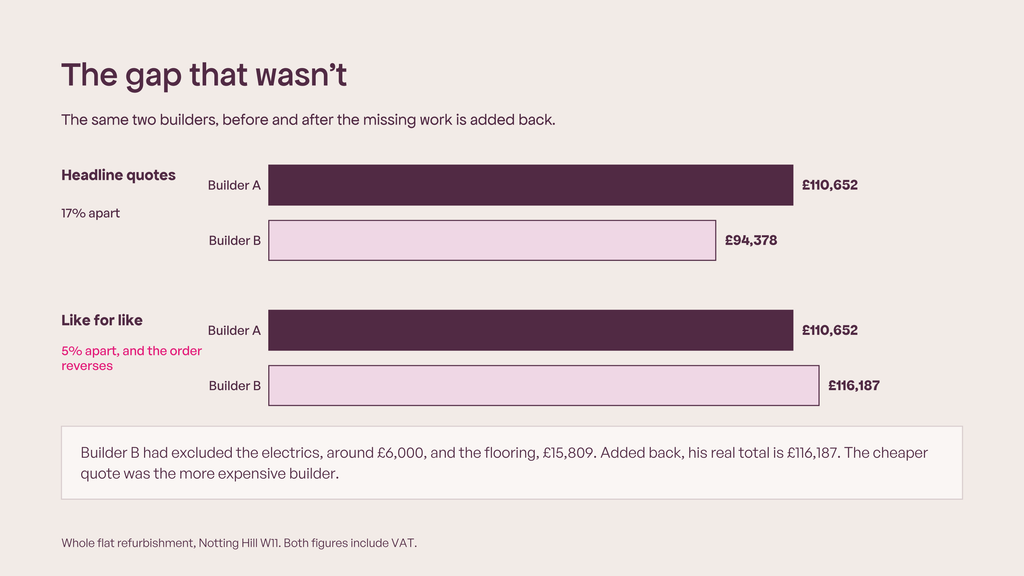
On that W11 flat, Builder B’s headline was £94,378 against Builder A’s £110,652. Builder B had excluded the electrics, around £6,000, and the flooring, £15,809. Added back, Builder B came to £116,187 against Builder A’s £110,652. A gap of 17% in one direction became a gap of 5% in the other.
Use the other builder’s price as your add-back figure. It’s the best evidence you have of what that work costs on your site.
4. Check the basis of every price, not just the number
Two figures can look identical and behave completely differently once work starts, make sure you consider:
- Fixed price. A sum for defined work. This is what you want most lines to be.
- Provisional sum. A placeholder for work that can’t be fully defined yet, usually because it’s hidden. It will be replaced by a real price later.
- Prime cost sum. An allowance for an item you haven’t chosen yet, typically tiles, sanitaryware or ironmongery. Choose something dearer and you pay the difference.
- Rate based pricing. Per point, per square metre, per linear metre. On an SW11 flat, one builder priced electrics at £2,465 per point and flooring at £39 per square metre over an estimated 49m². Both figures move the moment someone counts and measures. The other builders priced the same work as fixed sums.
If one quote is mostly fixed and the other is mostly provisional, the fixed one carries far more risk for the builder, and that’s reflected in the price. You’re not comparing like for like.
Also confirm VAT on both. A builder turning over less than the VAT registration threshold of £90,000 doesn’t have to register and won’t charge it. On a £40,000 job that’s £8,000 between two builders doing identical work. And some residential work qualifies for a reduced 5% rate rather than 20%, most commonly where a property has been empty for two years or more, or where you’re changing the number of dwellings. The rules sit in HMRC’s VAT Notice 708. “£45,000” and “£45,000 plus VAT” are £9,000 apart.
5. Compare what isn’t priced work
Once both quotes cover the same scope, most of the remaining difference is in things that never appear as a line item.
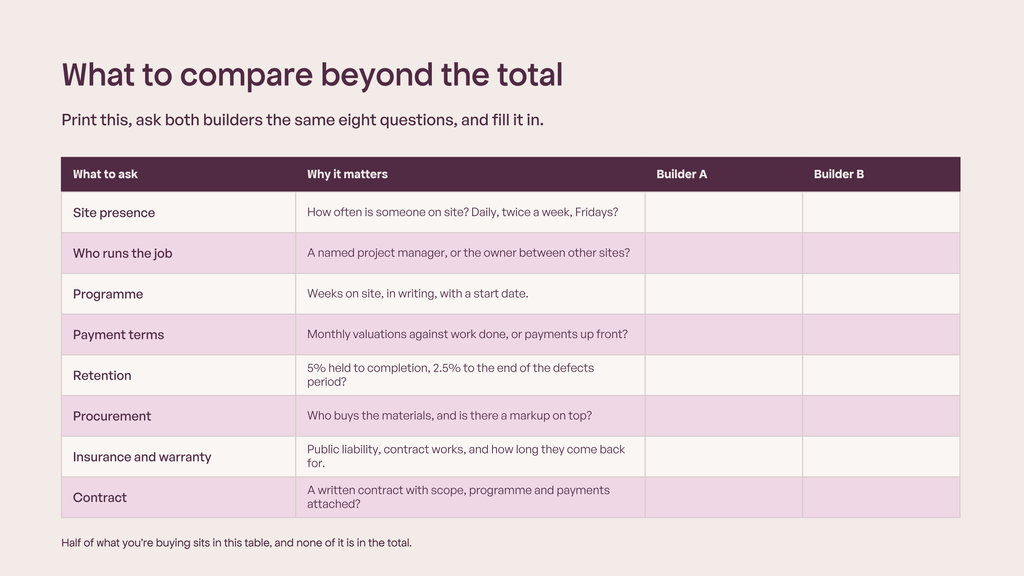
- Site presence. Daily, twice a week, or a phone call on Friday. Ask directly.
- Who runs the job. A named project manager, or the owner between three other sites.
- Programme. On the CR8 job, the two quotes were 8 to 10 weeks and 10 to 12 weeks. Two extra weeks of rented accommodation is a real cost that appears in neither quote.
- Payment terms. Monthly valuations against work completed is the standard to aim for. A large deposit and stage payments ahead of the work is how homeowners lose money.
- Retention. Typically 5% held until practical completion and 2.5% until the end of the defects period. If one builder offers it and the other doesn’t, that’s worth real money.
- Procurement. Who buys the materials, who takes the trade discount, and whether the builder charges a percentage on top.
- Insurance and warranty. Public liability cover, contract works cover, and how long they’ll come back for. Ask for the certificates, not the assurance.
- Contract. A written contract with a scope, a programme and a payment schedule attached, or an email saying yes.
6. Now compare the totals
By this point the totals mean something, because they describe the same project. Two levelled quotes with a schedule of works behind them usually land 5% to 15% apart.
What a line by line comparison actually shows
The idea of a cheap builder and an expensive builder mostly dissolves once you read the detail.
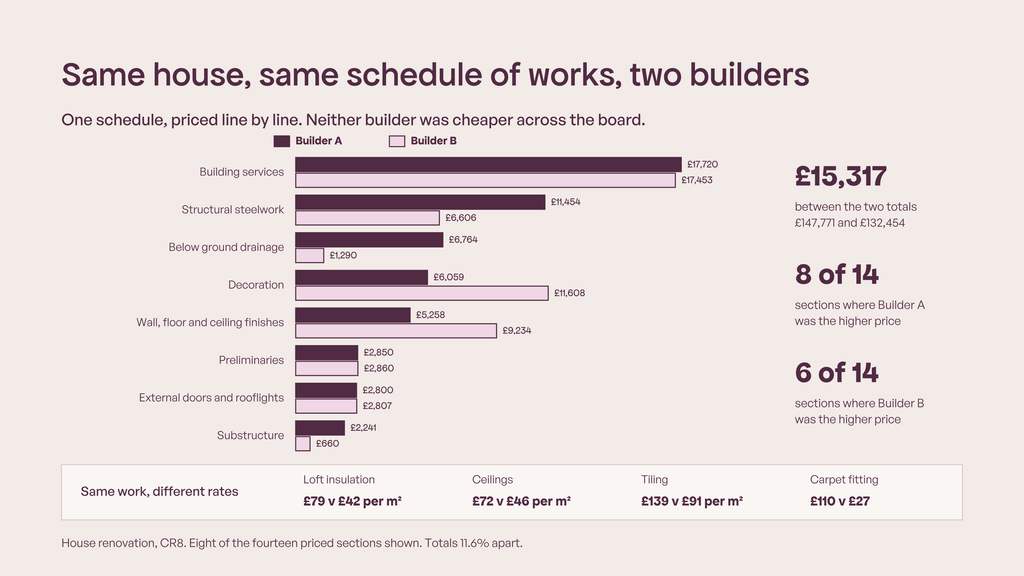
On that CR8 house we issued one schedule of works and both builders priced every line.
The totals came back £15,317 apart, £147,771 against £132,454. Underneath, Builder A was higher on eight sections and Builder B on six. They were within £10 of each other on preliminaries and within £7 on external doors and rooflights, then thousands apart on drainage, steel and decoration.
Neither builder was cheaper across the board. That’s the argument for reading line by line, and it’s also where negotiation actually lives. You now know exactly which sections to question, and you can ask each builder about their own outliers rather than haggling over a total.
Does the type of builder change the quote?
It changes what you’re buying, which is why two totals can be a fair distance apart and both be right.
A sole trader is often the best value on a single room, works on fewer jobs at once, and may not be VAT registered. That alone is an instant 20% difference with nothing to do with the work.
A small company is where most whole house renovations land. Enough management to run the trades, enough overhead to show in the price.
A larger contractor brings a site manager, a foreman and an office. That costs more because it is more, and on a complex or structural job it’s often the cheaper decision in the end.
Compare a sole trader’s total against a managed contractor’s total and take the lower one, and you haven’t saved money. You’ve bought a different service. Ask both the same questions about site presence, programme and payment terms, and the difference stops looking like price.
Five red flags when you’re comparing two quotes
- One quote is a single number. No sections, no quantities, no exclusions. It isn’t a quote, it’s an estimate whatever the heading says.
- Round numbers throughout. £5,000 for the bathroom, £10,000 for the kitchen. Nobody priced that. They guessed it.
- A deposit of 25% or more before anyone starts. Materials on order is a reason for a payment. A quarter of the contract value isn’t.
- The exclusions list is empty. Every real quote excludes something. An empty list means it hasn’t been written down, not that nothing is excluded.
- A price that drops when you mention the other quote. If £8,000 can come off without the scope changing, it was never priced properly. Ask what’s being removed.
What if the two quotes are within a few percent?
Then price has told you everything it can, and the decision moves entirely to the rest of the scorecard in step 5. Site presence, programme, payment terms, insurance and the quality of the two conversations you’ve had so far.
At that point the most useful question isn’t about money. It’s whether each builder has understood your project. The one who came back with questions about the drainage, the party wall or the steel usually has. There’s more on reading that signal in how do I know when a builder is good and not just friendly or well priced.
Is two quotes enough?
Three is better for larger renovations. Two gives you a comparison but no benchmark, so if both builders have misread the scope in the same direction, nothing tells you. Three gives you a middle. More than four and good builders lose interest, because tendering costs them a day of somebody’s time.
If you’ve only got two and one is a friend’s recommendation, be especially careful. A builder who was right for someone else’s project isn’t automatically right for yours. We’ve written about what a word of mouth recommendation is actually worth.
Should I show one builder the other builder’s quote?
No. Share the scope, never the numbers. Showing a builder a rival’s figure invites him to price to a target rather than to the work, and the money usually comes back later as a variation. If you want a builder to revisit a section, name the section and ask him to explain his allowance. That’s a fair question and a good builder will answer it.
How The Page makes quotes comparable
We write your schedule of works, put the identical scope to matched builders from our vetted network, then read every quote line by line so you don’t have to. You get one document setting price, scope differences, management, procurement, payment terms, warranty and programme side by side, with the differences explained in plain English.
Common questions
How do I compare two builders’ quotes that cover different work? Level them first. List what each quote excludes, then add the missing items into the column where they’re absent, using the other builder’s price as the figure. Compare only once both quotes cover the same scope.
Should I take the cheaper of two quotes? Only after you’ve levelled them. The cheapest quote is often the right one when it’s complete and itemised and the references check out. The problem is that a low quote and an incomplete quote look identical on paper, and missing work comes back as a variation at a price you can no longer negotiate.
How much should two quotes for the same job differ? With a written schedule of works behind them, roughly 5% to 15%. Our average across five London tenders in 2026 was 12%. Without a written scope the spread can be 100% or more, and that’s telling you about the brief, not the builders.
What should I ask both builders before deciding? The same six questions, in writing: what’s excluded, what’s provisional or prime cost, who’s on site and how often, what the programme is, what the payment terms and retention are, and what insurance and warranty you get.
Do I need a schedule of works to compare two quotes? It’s the difference between comparing and guessing. Without one, each builder prices their own version of the job. With one, both price the same lines and the comparison does itself.
Do builders’ quotes include VAT? Not always. A builder turning over less than £90,000 a year isn’t VAT registered and won’t charge it. Always ask whether a figure is inclusive or exclusive, and whether the reduced 5% rate applies to your property.
Can I negotiate using the other quote? Negotiate on sections, not on totals, and never by sharing figures. “Your drainage allowance is well above the other price I’ve had, can you talk me through it” is a fair question. “Beat this number” isn’t.
George Harris
April 24, 2025Renovate the savvy way
- Simplified process with support throughout
- Pay the right price for proven Pagers
- Transparent pricing & timelines
SHARE THIS ARTICLE