Back to blog
Every renovation hits a problem. What matters is how it’s handled.
Every problem needs a solution, we make sure you know what steps to take every single time.

Ask anyone who has been through a renovation and they will tell you the same thing. Something went sideways. A delivery landed three weeks late, the final invoice came in higher than the number in their head, the builder went quiet for a stretch, or the site looked like a bomb had gone off and nobody had warned them it would. It’s so common that the entire industry has quietly agreed on the word for it. Inevitable.
So if the problems are inevitable, the honest question is not how to avoid them entirely, but instead who is standing next to you when one of them lands, and whether that person actually knows how to sort it out.
That is where most of the renovation industry falls short, and it’s exactly what we built The Page for.
Renovation problems are more predictable than you think
Common renovation problems are not a mystery. Across thousands of projects the same small handful of issues come up again and again, which means they can be anticipated, spotted early, and resolved before they turn into something bigger.
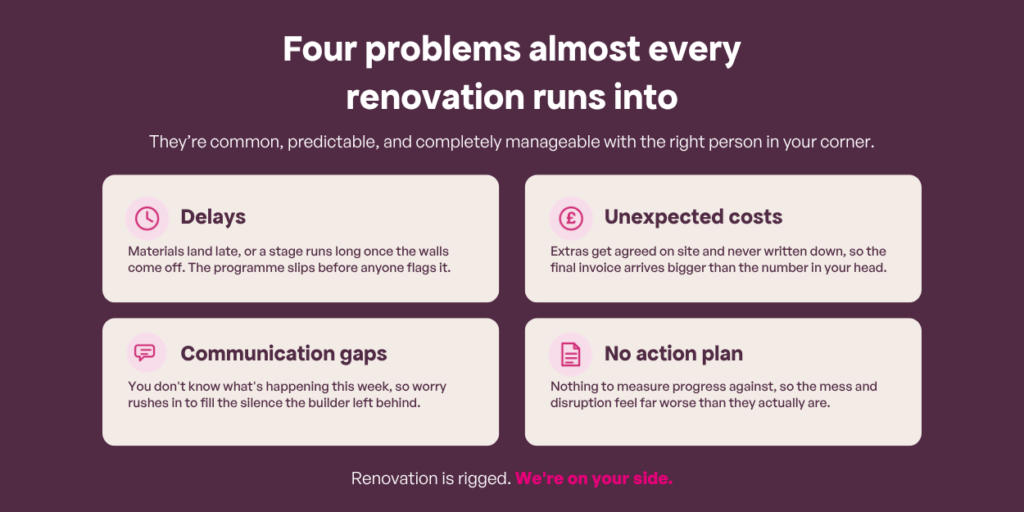
The first is delays: Usually driven by materials arriving late or a bit of the job taking longer than expected once the walls come off.
The second is unexpected costs: Which almost always trace back to variations, meaning changes to the original scope that were agreed on site verbally and never written down.
The third is a communication gap: Where the homeowner simply does not know what is happening this week and starts to fill the silence with worry.
The fourth is the absence of a clear written plan: Nobody is quite sure what “on track” is supposed to look like, and the mess and disruption feel far worse than they are because there is no structure to measure them against.
If you have been burned before, I bet you’ll recognise at least one of these! If this is your first renovation, this is the moment to know that these are the norm, not the exception, and having someone who’s experienced in your corner changes how each of them plays out.
Real problems, and how we solved them for the homeowners
We think the best way to show what support looks like is to show you the moments it mattered and where we stepped up. The names and builder details have been removed for privacy, but the situations, and the way we worked through them, are exactly as they happened.
😳 The surprise final invoice
A homeowner reached the end of their project and the final invoice came back much higher than expected. Underneath it was a familiar pattern; extra bits of work had been agreed along the way, but the communication between homeowner and builder about those changes had been patchy, and very little of it had been written down. Both sides genuinely believed they were right, which is usually the case when variations go unrecorded, and the back and forth was starting to sour a relationship that had been fine up to that point.
What we did was simple and it worked. We asked both of them to come on a call so we could go through it properly, hear both points of view in one place, and find a resolution rather than trading messages that hardened each side’s position. Getting everyone into the same conversation, calmly, turned a dispute back into a negotiation. They needed someone to hold the room.
⏳ The delay nobody had explained
On another project, materials were late, which slowed progress on site, and the homeowners had not been told to expect any of it. From where they were standing, the job had simply stalled. There was a second layer too, they were having some friction on an electrical report and exactly what it needed to cover, with the builder and homeowner working from different understandings of what was required.
We worked through a plan with the builder to set out clear next steps and, importantly, what those next steps would actually look like on site, so the homeowners could see progress rather than guess at it. The builder was able to provide the report for the work he had done, and we stayed close to the homeowners with regular check-ins and an overview call so that everyone was reading from the same page. Most of the heat in that situation was not the delay itself. It was not knowing. Once we closed the information gap, the project settled.
📝 The homeowner who needed to see the plan
A homeowner who was heavily pregnant grew understandably anxious as the project went on, because she could not see the shape of what was coming and she was running out of runway before the baby arrived. What she asked for was reasonable and specific. She wanted the builder to sit down with her on site, map out the structure of the remaining work, and keep her genuinely in the loop rather than leaving her to wonder.
So that is what we arranged. We got the builder on site to build the plan with her, in person, and set up check-ins that ran nearly daily during the period that mattered most. Nothing about the underlying work changed. What changed was that she could see it, understand it, and trust it, at exactly the moment she most needed to feel in control.
🧭 The mess with no map
The last one will be familiar to a lot of first-time renovators. A homeowner had no written structure for the project from the builder and had not expected the sheer amount of disruption that a live building site brings. There was nothing wrong with the work. There was no framework around it, so every bit of dust and every displaced day felt like evidence that things were going wrong when they were not.
We arranged a site visit so the builder could walk the homeowner through the plan in person, out loud, pointing at the actual rooms, and then we checked in straight after to make sure it had landed. The builder was not keen on producing a daily blow-by-blow, which is fair, but that was never really the ask. The ask was structure and reassurance, and a face-to-face walk-through of the plan delivered both.
Notice the pattern
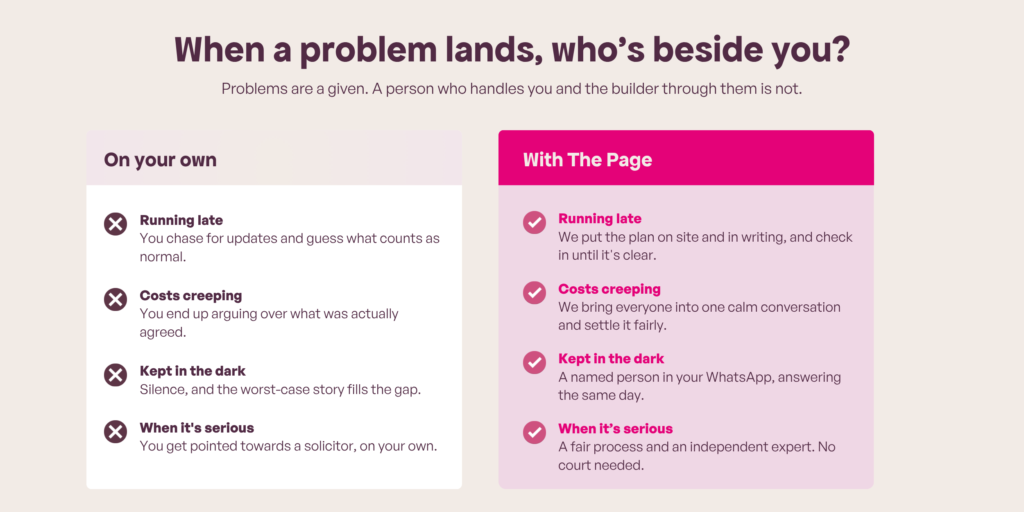
Look back across those four stories and the resolution is almost the same shape every time, even though the problems were different. We get the right people into the same conversation, whether that is a call or a site visit. We turn something vague into something written down and explicit, so it can be measured and agreed. Then we keep checking in, so nobody has to sit alone with a worry until it grows.
That pattern is not luck, and it’s not us being nice. It’s a method. Every credible source on building disputes tells homeowners the same three things, that changes should be recorded, that issues should be raised early and in writing, and that keeping a clear record is what protects you if things escalate. The difference is that the industry hands you that advice and then leaves you to do it yourself, at the exact moment you are most stressed, least experienced, and least equipped to hold your own against a builder who does this every day. We do it with you, and often for you.
Why the industry isn’t built for this, and we are
Here is the uncomfortable truth about how most renovation services work. They are brilliant at the front door. Matching platforms, directories, lead sites and even word of mouth help you connect with a builder but then they step back. As we have seen looking closely at how the whole category behaves, the industry has built excellent front doors and almost no back walls. The friendly named person who helped you at the start tends to disappear the moment work begins, which is precisely the moment you need someone the most.
We built The Page the other way around. You get a real, named person, your Page Renovation Partner, who stays with you through the whole project and is reachable in your WhatsApp group rather than hiding behind a ticket system. When something comes up, you raise it there, and we acknowledge it the same working day, speak to your builder, and come back with a clear answer or an agreed plan. Most concerns are resolved within 48 to 72 hours. If something is more serious, there is a structured route behind that, a fair process with a written response window and, where needed, an independent expert whose report becomes the shared basis for putting things right. You are never left to improvise your way through a dispute on your own.

Proof, not promises
We are not asking you to take the stories on faith. The way we work shows up in the numbers and in what people say once it’s over.
We accept fewer than 7% of the builders who apply to join us, so the person on your project has already cleared a bar most can’t. Our quote reviews bring competing prices to within around 5% of each other on a like-for-like basis, which is how surprise costs get caught before they reach your inbox rather than after. We are rated Excellent at 4.9 on Trustpilot, and we have supported more than 1,200 London homes through exactly the kind of moments described above.
The best time to fix a problem is before it starts
If there is one thing to take from all of this, it’s that the smartest move a homeowner can make is to talk to us before you approach a single builder, not after something has already gone wrong. That is when we can set the project up so the common problems are anticipated, the scope is written down properly, and you have someone in your corner from day one rather than calling for help halfway through a crisis.
Renovation is rigged. We’re on your side. If you would like someone experienced standing next to you before the first brick moves, book a free briefing call and we will talk you through exactly how we would approach your project.
Frequently asked questions
Are problems during a renovation normal?
Yes. Delays, variations, the occasional communication gap and unexpected findings once work begins are all common on building projects, which is why the industry itself describes them as inevitable. A good renovation is not one where nothing goes wrong. It’s one where problems are spotted early and resolved calmly, ideally by someone experienced acting on your behalf.
What should I do if my builder sends a final invoice that is higher than the quote?
Do not pay it under pressure and do not fire off an angry message. Gather everything that was agreed, especially any changes discussed on site, and ask for a conversation where the extra costs are explained line by line. The fairest outcomes come from getting both sides into one calm conversation with a clear record, which is exactly the kind of situation we step into on our customers’ behalf.
Should renovation changes always be put in writing?
Yes, without exception. The single biggest cause of unexpected renovation costs is a change agreed verbally on site and never recorded. Getting every variation written down, with its cost and timing impact, protects you and the builder equally. We prompt for this throughout a project so nothing slips through.
How does The Page help when something goes wrong mid-project?
You raise it in your WhatsApp group or directly with your Page Renovation Partner, and we acknowledge it the same working day. We speak to your builder and come back with a clear answer or an agreed plan, and most concerns are resolved within 48 to 72 hours. For anything more serious there is a structured, fair process behind that, including an independent expert where needed.
When is the best time to get support for my renovation?
Before you approach any builders. Getting the scope written down properly and having an experienced person in your corner from the start is far more effective, and far less stressful, than calling for help once a problem has already taken hold.

Thinking about a renovation?
- Book a free briefing call before you approach any builders
- We’ll be by your side from the first call to final snag
Tags
Renovate the savvy way
- Simplified process with support throughout
- Pay the right price for proven Pagers
- Transparent pricing & timelines
SHARE THIS ARTICLE