Back to blog
What is a Schedule of Works?
The document behind every quote you can actually trust. Here’s what it is, and why it’s important!

If you have ever gathered three quotes for the same renovation and found yourself staring at numbers that range from six thousand pounds to twenty-two thousand for what you thought was identical work, you already understand the problem a schedule of works exists to solve. You are not comparing builders at that point, you are comparing guesses, because each person has quietly priced a slightly different version of your project. A schedule of works is the thing that stops that happening, and getting your head around it early is one of the most useful moves you can make before a single builder sets foot in your home.
This guide explains what a schedule of works is in plain terms, how it differs from a scope of works and a bill of quantities, what a good one actually contains, who writes it, and why it quietly decides whether your renovation runs to budget or runs away from you.
So, what is a Schedule of Works?
A Schedule of Works is a written document that lists, in order and in detail, every item of work a renovation involves. It describes each task by room or by trade, sets out the materials and finishes, and makes clear who is responsible for what. Think of it as the instruction manual for your project, written before anyone picks up a tool, so that every builder pricing the job is working from exactly the same brief rather than filling in the blanks with their own assumptions.
Unlike a quote, a schedule of works does not start with a price, it starts with the work. The price comes afterwards, once a builder has read the document and costed each line against it. That order matters more than it sounds, because when the work is defined first and priced second, you finally get quotes that line up against each other. When it’s the other way around, you get the six-to-twenty-two-thousand difference, and no real way to know which builder is expensive, which is cheap, and which has simply left half the job out.
For a typical bathroom or kitchen, a Schedule of Works might run to a few pages. For an internal refurbishment or an extension it can be considerably longer and will sit alongside drawings from an architect or designer. The level of detail flexes with the size of the project, but the principle holds at every scale, which is that clarity written down at the start is what protects you later.

Schedule of Works, Scope of Works, Bill of Quantities: what’s the difference?
These three terms get used interchangeably, but they are not quite the same thing and it helps to know which is which.
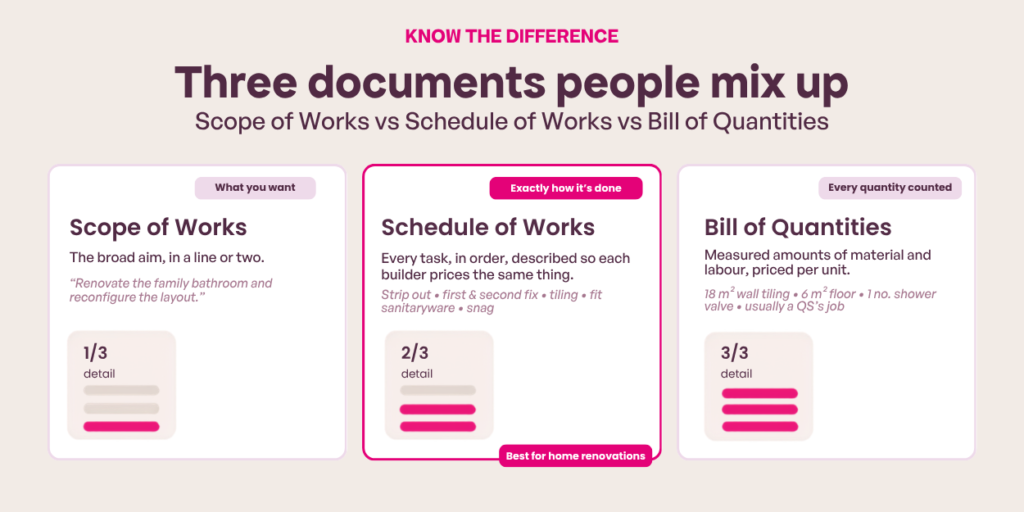
A Scope of Works is the broad description of what a project sets out to achieve. It can be quite general, sometimes no more than a paragraph saying “renovate the family bathroom and reconfigure the layout.” It tells you the intention, not the instructions.
A Schedule of Works is more specific. It takes that intention and breaks it down into an ordered list of every task required to deliver it, with enough detail that a builder can price each line accurately. It’s the working document a builder actually quotes against, and on smaller renovation projects it’s the practical alternative to the heavier documents used on larger jobs.
A Bill of Quantities goes a step further again. Usually prepared by a quantity surveyor, it measures and quantifies everything, listing precise amounts of material and labour so that contractors price per unit. It’s thorough and brilliant for major works, but for most home renovations it’s more than the job would need. This is why, on the kind of bathroom, kitchen and refurbishment projects most homeowners are planning, a well written schedule of works hits the sweet spot of being detailed enough to give you comparable quotes without being so elaborate that it slows everything down.
A useful way to remember it: a scope of works says what you want, a schedule of works says exactly how it will be done, and a bill of quantities counts every nut and bolt it will take to do it.
Why does a Schedule of Works matter more than most homeowners realise?
It’s tempting to treat a Schedule of Works as paperwork, a box to tick before the interesting part begins. In practice it does at least four jobs that protect you, and most of the renovation horror stories we hear can be traced back to one of them being skipped.
The first job is making your quotes comparable.
This is the one homeowners feel most immediately. One builder itemises everything, another hands you a single lump sum, and suddenly you cannot tell whether the cheaper quote is genuinely better value or simply less complete. We saw exactly this on one project where a homeowner had two quotes in front of her, one crystal clear but expensive and one cheaper but vague, and she had no way to weigh them against each other because they were not describing the same job. When every builder prices the same schedule of works, that fog lifts. You compare like with like, and the detail itself starts telling you something about how each builder works.
The second job is controlling cost and pinning down what is included.
A surprising amount of renovation pain comes from things that were never written down. One homeowner came to us after a six thousand pound invoice landed for work she had never agreed to. Another watched the skips multiply on a job that had quoted for two and ended up ordering a fourth, with no idea how many more were coming. A clear schedule of works heads this off, because anything not explicitly excluded at the quoting stage is treated as included. The exclusions have to be stated up front, in writing, which means the builder cannot quietly leave out groundwork or certification and then bill for it as an extra halfway through.
The third job is setting the running order.
A renovation has a logic to it, first fix before plaster, plaster before second fix, decoration near the end, and getting that sequence wrong is one of the most expensive mistakes going, because you end up paying twice for work that has to be ripped out and redone. A schedule of works lays the order out so that everyone on site is working to the same plan, which is exactly the guidance first-time renovators tell us they are crying out for when they say they simply do not know what is meant to happen when.
The fourth job is becoming the backbone of your contract.
Once you have chosen your builder and agreed a price, the schedule of works you both signed off becomes part of the contract between you. That single fact is what gives the agreed price its staying power, because any change to the work is then handled as a recorded variation with its own agreed cost, rather than a vague conversation you half remember three weeks later.

What goes into a good schedule of works
There is no single official template, which is part of why the document trips people up, but the strong ones tend to share the same bones. A schedule of works worth its salt will usually include:
- A short project summary, covering the property, the overall scope, and the rough timeline, so anyone reading it understands the job in a sentence or two before diving into the detail.
- The works themselves, broken down by room or by trade, in the order they will happen, with each task described specifically. “Install kitchen” is not a line in a good schedule. “Supply and fit elements, worktops and specified appliances, including all connections” is closer to it.
- Materials and finishes, named where the choice matters, because “tiling” priced by one builder against a budget tile and another against a hand made one is not a fair fight.
- Responsibilities, making clear who supplies what and who is accountable for each element, which is where a lot of expensive misunderstandings quietly live.
- Exclusions and assumptions, stated openly, so there are no nasty surprises about what was never in the price.
- A note on programme, giving each stage a realistic duration, so the timeline is a shared expectation rather than something you discover as you go.
The more precisely these are written, the less room there is for a quote to come in artificially low and climb later. Detail is not bureaucracy here, it’s protection and the single biggest lever a homeowner has over how smoothly the whole thing runs.
Who writes a schedule of works?
Traditionally the schedule of works is written by whoever is responsible for the design, so on a larger project that is your architect or designer, and on a structural job it would be reviewed by a quantity surveyor before it goes out. On a straightforward internal refurbishment, a bathroom or a kitchen with no walls moving, you can absolutely prepare one yourself if you are thorough and willing to do the research on materials and sequencing. At The Page we build you your own Schedule of Works and work with our Pagers or partnered Architects to piece together your project.
The honest truth, though, is that most homeowners are doing this for the first time, there is no shame in not knowing the running order of a renovation you have never done before, and a good schedule of works is partly there to carry that knowledge for you so you do not have to hold it all in your head.
This is the gap we built The Page to close, particularly for homeowners who are new to London or do not have a builder in the family to lean on, the people who would normally rely on a word-of-mouth recommendation and simply do not have one to call.
How a schedule of works gives you genuinely comparable quotes
Here is where the document does its most valuable work, and where our own service is built around it. We call it the Tender Pack, and the idea is simple. We write a proper schedule of works for your project, we put that exact same scope to three vetted builders from our network, and we hand you one clear comparison across price, management and builder style. Because all three are pricing the identical schedule, you are finally choosing on the things that actually matter rather than trying to reverse engineer three documents that were never meant to be read side by side.
It’s worth saying plainly that you do not have to do it this way. Plenty of homeowners gather their own quotes without a schedule of works and get a perfectly good result, and we would never pretend otherwise. What the schedule of works changes is the amount of guesswork you are carrying when you make the decision, and for a project costing tens of thousands of pounds, taking the guesswork out tends to be worth the effort.
The builders we put your schedule to are not pulled from a directory. Fewer than seven percent of the contractors who apply to join our network are accepted, and once they are in, they are expected to deliver within five percent of their original quote and timeline or face review. That is the difference between a name and an accountable relationship, and it’s why a schedule of works in the right hands is so much more than a piece of admin. One recent homeowner described the WhatsApp group they had with us through the whole quoting process as “instrumental”, and that support, the sense that someone knowledgeable is in your corner before the build even starts, is really what the document makes possible.

Common questions about a schedule of works
Do I need a schedule of works for a small bathroom renovation?
You do not strictly need one, but even on a small bathroom it pays for itself the moment you have more than one quote to compare. A shorter, simpler schedule of works is plenty for a project with no structural changes, and it still stops builders pricing different versions of the same room.
Is a schedule of works the same as a quote?
No. A quote is what a builder gives you after reading a schedule of works. The schedule defines the job, the quote prices it. If you are being quoted without any agreed description of the work, that is usually where future disputes begin.
Can a schedule of works be changed once the work starts?
Yes, and most renovations do change as they go. The point is that with a schedule of works in place, any change is handled as a recorded variation with its own agreed price, rather than an informal request that turns into an argument over the final bill.
The bottom line
A schedule of works is not the exciting part of a renovation, but it’s the part that quietly determines how the exciting parts turn out. It’s what turns three incomparable quotes into a fair decision, what keeps your agreed price agreed, and what gives you a running order to hold your builders to. For first-time renovators it removes the fear of not knowing what to ask, and for anyone who has been burned before it puts the protections in writing where they belong.
If you are at the stage of gathering quotes and that spread of numbers is making your head spin, the most useful thing you can do is sort out the document before you sort out the builder. We are happy to help you do exactly that.

Thinking about a renovation?
- Book a free briefing call before you approach any builders
- We’ll talk you through the schedule of works and what your project should really involve.
Tags
Renovate the savvy way
- Simplified process with support throughout
- Pay the right price for proven Pagers
- Transparent pricing & timelines
SHARE THIS ARTICLE