Back to blog
Should the kitchen units be in the builder’s price or bought separately?
Work out whether you’d save money by adding your kitchen to your builders quote.
The short answer: Buy the kitchen separately if your project is standard rated for VAT and you’ve chosen a brand you can buy direct. Put it in the builder’s price if your project qualifies for the reduced 5% VAT rate, or if the kitchen only sells through trade accounts.
The longer answer matters more, because the decision changes who’s responsible when a door arrives damaged, who pays for the week everyone stands around waiting, and whether your quotes are comparable at all.
Whoever supplies the kitchen owns the problem when something’s wrong with it.
The single most expensive version of this decision is not making it. If one builder has priced the kitchen and another has written “kitchen by others”, you aren’t looking at two prices for the same project. You’re looking at two different projects.
The three ways a kitchen actually gets bought
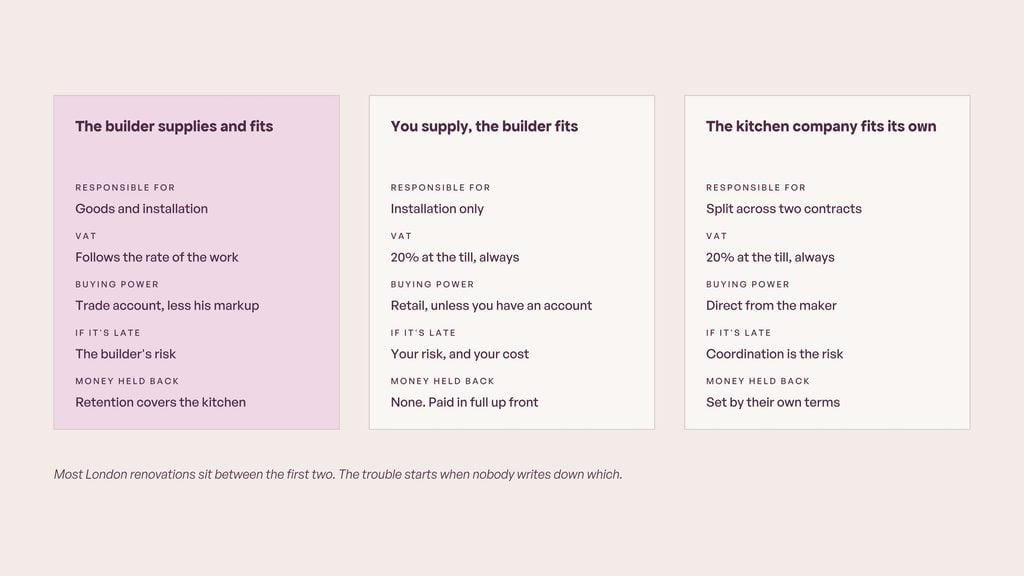
Three routes, in plain terms:
- The builder supplies and fits. The kitchen sits inside the contract sum, priced as a line or held as a prime cost sum until you choose. One party is responsible for the goods and the installation.
- You supply and the builder fits. Sometimes called free issue or client supply. You buy the kitchen, it’s delivered to site, and the builder’s price covers only the labour to install it and everything around it.
- The kitchen company supplies and fits its own units. Common at the higher end, where the manufacturer insists on its own installers. Your builder prepares the space, runs the services, and returns afterwards for tiling, decorating and making good. You now have two contractors on one programme.
Most London renovations end up somewhere between routes one and two, and the trouble usually starts because nobody wrote down which.
The VAT point that decides it for some projects
![When the VAT rate makes the decision for you." Worked example on a £25,000 kitchen, illustrative. Standard rated project: builder supplies £25,000 plus 20% = £30,000, you supply £25,000 plus 20% = £30,000. No difference. Reduced rate project at 5%: builder supplies £25,000 plus 5% = £26,250, you supply £25,000 plus 20% = £30,000. Difference £3,750. Footer: the reduced rate applies to what the builder supplies and installs, not to what you buy yourself. Source: VAT Notice 708, section 2.2.]](https://www.the-page.co.uk/wp-content/uploads/2026/09/the-page-cheapest-quote-infographics.pptx-2-1024x576.jpg)
Most renovations are standard rated, and on those the VAT is 20% whoever hands over the card. The decision is about risk, not tax.
But some residential work qualifies for a reduced 5% rate instead of 20%, most commonly where a property has been empty for two years or more, or where you’re changing the number of dwellings. The rules sit in HMRC’s VAT Notice 708, and section 2.2 is the line that matters here: builders charge VAT on the materials they supply and incorporate at the same rate as their work.
So on a project that qualifies, a kitchen the builder buys and fits carries 5% VAT. The same kitchen bought by you carries 20% at the retailer, and nobody can reclaim the difference. On a £25,000 kitchen that’s £3,750, before anyone has talked about trade discount.
Fitted kitchen units count as building materials for this purpose. HMRC’s own guidance is explicit that finished or prefabricated kitchen furniture, and materials for building fitted kitchen furniture, are building materials. Most appliances are not, so your oven, fridge and dishwasher stay at 20% either way.
If your project qualifies for the reduced rate, put the units in the builder’s price and buy the appliances yourself. That one decision is worth more than most negotiations.
What you’re really paying for when the builder supplies
A builder who supplies your kitchen adds something to the cost. Usually 10% to 20%, sometimes described as handling, sometimes buried in the rate.
That isn’t a swindle, and it’s worth understanding what it buys. He’s paying the supplier before you’ve paid him, so he’s funding it. He’s checking the delivery, storing it dry and secure, chasing the replacement when a door arrives with a chip in it, and standing behind it for the length of his warranty. When a hinge fails in month nine, you ring one number.
Set against that, he may be buying better than you can. Some of the ranges builders use, Howdens being the obvious one, don’t sell to the public at all. If you want that kitchen, the builder buys it or nobody does. Whether the trade discount reaches you or stays with him is a fair question to ask, and a good builder will answer it.
The honest comparison isn’t the markup against zero. It’s the markup against the value of never having to sort out a damaged carcass yourself.
What breaks when a client supplied kitchen turns up late
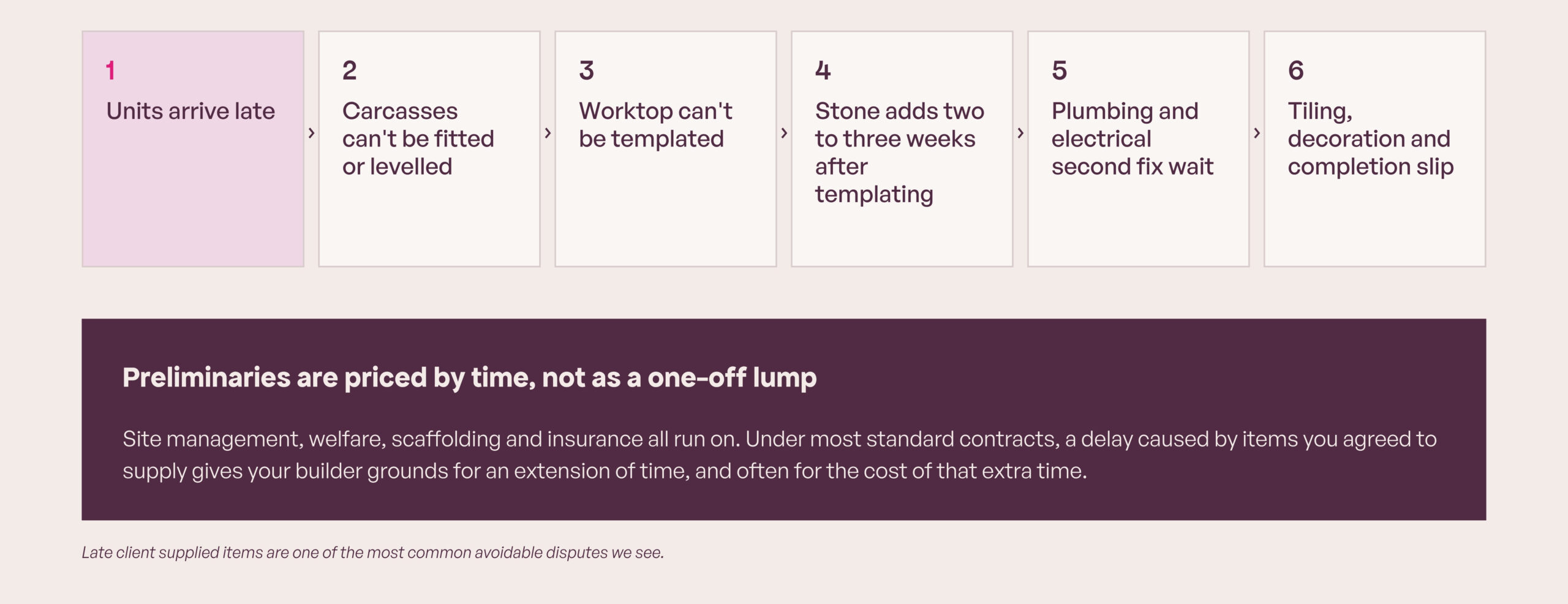
This is the failure we see most often, and it’s almost never the builder’s fault.
Worktops are the reason. On most projects the worktop can’t be ordered until the carcasses are in and levelled, because it’s templated off the units as built. Then it’s fabricated. That’s commonly another two to three weeks on stone. So a kitchen that arrives a fortnight late doesn’t cost you a fortnight. It pushes the template, which pushes the worktop, which pushes plumbing second fix, electrical second fix and testing, tiling, and final decoration. Everything after the kitchen queues behind it.
And the meter is running. Preliminaries, which cover site management, welfare, scaffolding and insurance, should be priced as a time-based figure rather than a one-off lump. If they aren’t, the delay still costs the builder money, and he’ll find it somewhere. Under most standard contracts, a delay caused by items you agreed to supply is grounds for an extension of time, and often for the extra cost of that time.
Put simply, if you buy the kitchen, you’ve taken on the programme risk for it.
The fix is not complicated. Get the confirmed delivery date in writing before the builder prices the project, not after. Order early enough that the kitchen sits in your garage for a fortnight rather than the site sitting empty for a fortnight.
Who’s responsible when a door arrives damaged
When the builder supplies the kitchen, the goods are part of what he sold you. Under the Consumer Rights Act 2015, goods supplied under a contract must be of satisfactory quality and as described, and the service must be carried out with reasonable care and skill. Both obligations sit with him.
When you supply the kitchen, only the second one does. His duty is to fit it properly. If a door arrives warped, that’s between you and the kitchen company, and you’ll be having that conversation having already paid them in full, months earlier, with nothing held back.
Then there’s the version nobody plans for, where the door is damaged and neither party accepts it arrived that way. We’re currently supporting a homeowner on a project where a specified material was replaced with a cheaper one without being raised, and our analysis concluded it was an undisclosed substitution rather than a matter of taste. That position was only reachable because there was a written specification and a paper trail. The same is true here. Photograph every delivery, check it against the order the day it lands, and record damage in writing before anyone lifts a carcass.
One more thing that gets missed. A builder’s contract works insurance covers his own materials on site. Your free issue kitchen, stacked in the hallway for three weeks, may not be covered by his policy or by yours. Ask both.
Why this wrecks quote comparison
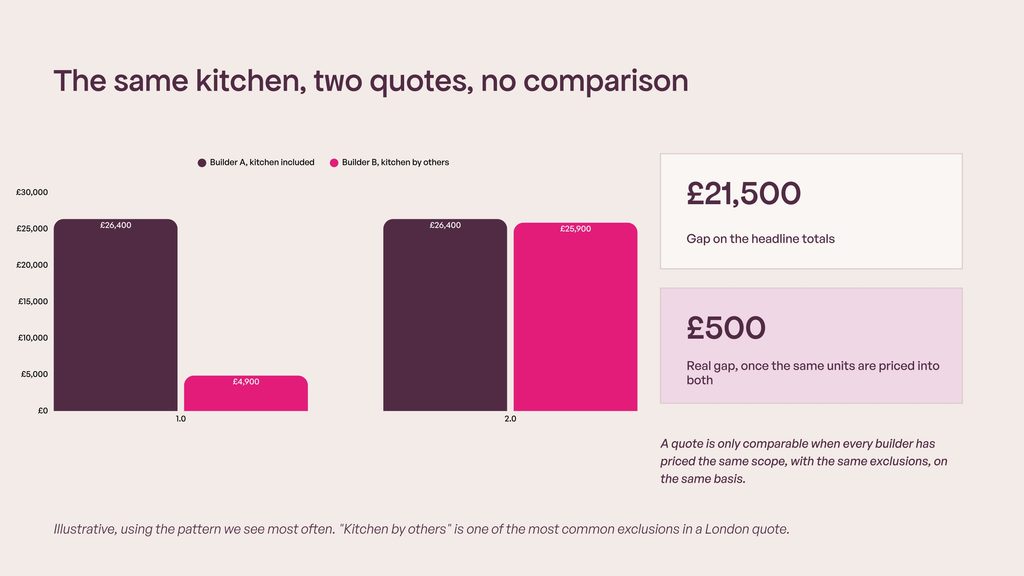
This is the part that costs homeowners real money, and it’s the reason we care about it.
Across five London tenders we ran in 2026, the gap between lowest and highest quote averaged 12%, and most of that gap turned out to be scope rather than price. On an NW8 renovation, one builder supplied and fitted new carpet to two rooms and the other prepared the floors and left the homeowner to find a fitter. Same house, same brief, and only one of those quotes ends with carpet.
Kitchens are the same pattern with a bigger number on it. “Kitchen by others” is one of the most common exclusions in a London quote, alongside worktops, stone and glazing. It’s a perfectly normal thing for a builder to write. It just means his total and the other builder’s total are measuring different things, and the difference can be twenty thousand pounds.
If you’re at the quote stage, there’s a step by step method in how do I compare two builders’ quotes fairly, and more on why the gaps appear in the first place in why is the cheapest quote usually the most expensive in the end.
The way to avoid the problem entirely is to decide before you tender, and tell every builder the same thing.
If you haven’t chosen the kitchen yet
Most people haven’t, at the point they’re getting builders in. That’s normal and it isn’t a reason to leave the line blank.
Use a prime cost sum. You state an allowance, say £18,000 for kitchen units supplied, every builder prices the same allowance plus their own labour to install it, and the figure is adjusted later against the real invoice. The comparison stays honest and the choice stays open.
What doesn’t work is letting each builder guess. One allows £8,000 because he’s thinking of a trade range, another allows £30,000 because he saw the interior designer’s board, and the totals tell you nothing about either builder.
The same logic applies to appliances, handles, taps and sinks. Name an allowance or name a product. Don’t leave it to interpretation, and be wary of an allowance that looks generous next to what you’ve actually been pricing on Saturday mornings.
So which should you choose?
For most standard rated London renovations, buy the kitchen yourself and have the builder price the installation. Three conditions:
- You order early,
- You get the delivery date agreed in writing before he prices the project,
- You accept that the units are your responsibility if something’s wrong with them.
Put it in the builder’s price when:
- Your project qualifies for 5% VAT,
- The range you want only sells through trade, Y
- ou’re not going to be around to take deliveries and chase replacements,
- You’d simply rather have one person accountable for the whole thing.
That last reason is a good enough reason on its own, and it’s the one homeowners underrate most.
Use the kitchen company’s own fitters when the manufacturer requires it, and then make the coordination somebody’s explicit responsibility rather than an assumption.
Decide before you tender, not after. The route matters less than everyone pricing the same one.

Common questions
Is it cheaper to buy the kitchen yourself? Usually a little, on a standard rated project, because you avoid the builder’s handling markup of roughly 10% to 20%. You take on the delivery risk, the storage, the replacements and the programme in exchange. On a project that qualifies for 5% VAT it’s the other way round, because the reduced rate only applies to what the builder supplies and installs.
Do builders mark up materials? Yes, and reasonably so. He’s funding the purchase before you’ve paid him, storing it, checking it, replacing what arrives damaged and standing behind it under his warranty. Ask what the markup is and whether the trade discount is being passed on. It’s a fair question.
Can I buy a Howdens kitchen myself? No. Howdens sells to trade accounts only, so it has to be bought by your builder or fitter. Several other ranges work the same way. If you want one of them, the kitchen goes in the builder’s price by default.
What happens if my kitchen is delivered late? If you supplied it, the delay is yours. Under most standard contracts your builder can claim an extension of time and, in many cases, the cost of that extra time on site. It also delays everything downstream, because worktops are templated off the fitted units and typically take another two to three weeks after templating.
Who is responsible if a kitchen door arrives damaged? The party who bought it. If the builder supplied it, the goods must be of satisfactory quality under the Consumer Rights Act 2015 and he sorts it out. If you supplied it, your builder’s duty is limited to fitting it with reasonable care and skill, and the claim is yours to make against the kitchen company.
Should the worktop be in the builder’s price? Usually not, and it’s frequently excluded as “by others”. Whoever supplies it, agree who does the template and when, because it can’t happen until the carcasses are in and it sets the date for everything after it.
Should appliances be in the builder’s price? Rarely worth it. Most appliances aren’t building materials for VAT, so there’s no reduced rate to gain, you’ll often buy better online than he can, and the manufacturer’s guarantee is yours either way. Just tell him exactly which models, because integrated units dictate cabinet sizes and services.
What’s a prime cost sum for a kitchen? A stated allowance for goods you haven’t chosen yet, priced identically by every builder and adjusted later against the real invoice. It keeps quotes comparable while you’re still deciding.
The bottom line
The kitchen is usually the largest single item in a renovation, and the question of who buys it decides who carries the cost of a late delivery, a damaged door and a failed hinge in month nine.
Buy it yourself if you’ll order early and you’re happy owning those risks. Put it in the builder’s price if your project qualifies for 5% VAT, if the range is trade only, or if you’d rather have one number to ring.
Then write the decision down, and give it to every builder before they price.
Tags
Renovate the savvy way
- Simplified process with support throughout
- Pay the right price for proven Pagers
- Transparent pricing & timelines
SHARE THIS ARTICLE