Back to blog
How many quotes should I get?
Two to four, and it depends on your job. Three is usually the golden number, but find out what you need below.
The most straightforward answer: get three. For most London renovations, three quotes is the right number. Two gives you a comparison but no benchmark, so if one builder has misread the job you have no way of knowing which one. Three gives you a middle, and the middle is what tells you whether the cheapest price is keen or simply incomplete.
Below about £30,000, two is usually enough. Above four, good builders start declining, because pricing a renovation properly costs them a day of somebody’s time and they can see the odds.
Three quotes is the point at which an outlier identifies itself. That’s the whole reason for the number.
Why three quotes rather than two?
With two quotes you have a difference. With three you have a pattern, and a pattern is the only thing that tells you which quote to trust.
On a kitchen and bathroom renovation in E8 this month, three builders priced the same written scope. The quotes came back at £80,171, £61,243 and £30,000, all excluding VAT.
That is not a price range. It’s three different projects.
The £30,000 arrived as a narrative quote in two lump sums, £20,000 for building works and £10,000 for the bespoke kitchen, with no line items, quantities or rates. Read against the scope, it carried no decoration at all, no waterproofing behind the bath, no bathroom joinery and no allowance for the cupboard the relocated boiler has to sit in. The £80,171 was priced labour only, so every material in the job sits outside it. The £61,243 came back with section totals and no rates underneath them.
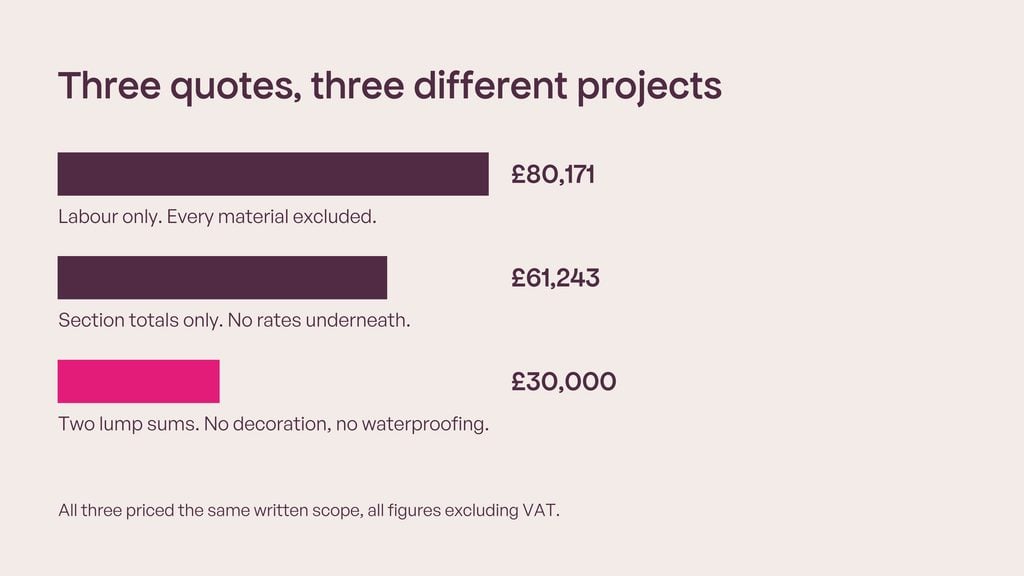
With only the first two quotes, you’d have had a 31% gap and a long argument about who was expensive. The third reframes the question entirely. Once you can see a £30,000 quote with no decoration line in it, you stop asking which builder is dearest and start asking what each price actually covers.
That’s the work the third quote does, it isn’t a third price – it’s the thing that makes the first two legible.
What happens when all three totals agree?
This is the case nobody warns you about, and it’s the strongest argument for three.
On a listed flat in SW5 this summer, three builders priced a whole-flat renovation. The totals came in at £176,425, £184,850 and £189,744 excluding VAT. A spread of 7.5%, which on a project that size looks like a well-run comparison and a market that agrees with itself.
The sections underneath told a different story.
- Decoration was £30,310, £39,293 and £76,574.
- The highest was two and a half times the lowest, on the same written lines: strip the lining paper from 280m² of wall, skim what’s damaged, two coats to 350m² of wall and 130m² of ceiling, satinwood to 300 linear metres of joinery.
- Preliminaries ran £5,644, £29,320 and £44,364.
- That’s site management, protection to the communal stairs of a third floor walk-up, welfare, waste and insurance. One builder allowed 20 weeks of foreman attendance at £1,050 a week. Another allowed the same 20 weeks at £350. The third had barely allowed for it at all.
And the programmes were 10 to 14 weeks, 12 to 16 weeks, and 20 to 24 weeks. Same flat, same scope, one builder expecting to be there twice as long as another.
The lowest total was also the one missing whole sections; no stair runners, no fireplaces, no window repairs.
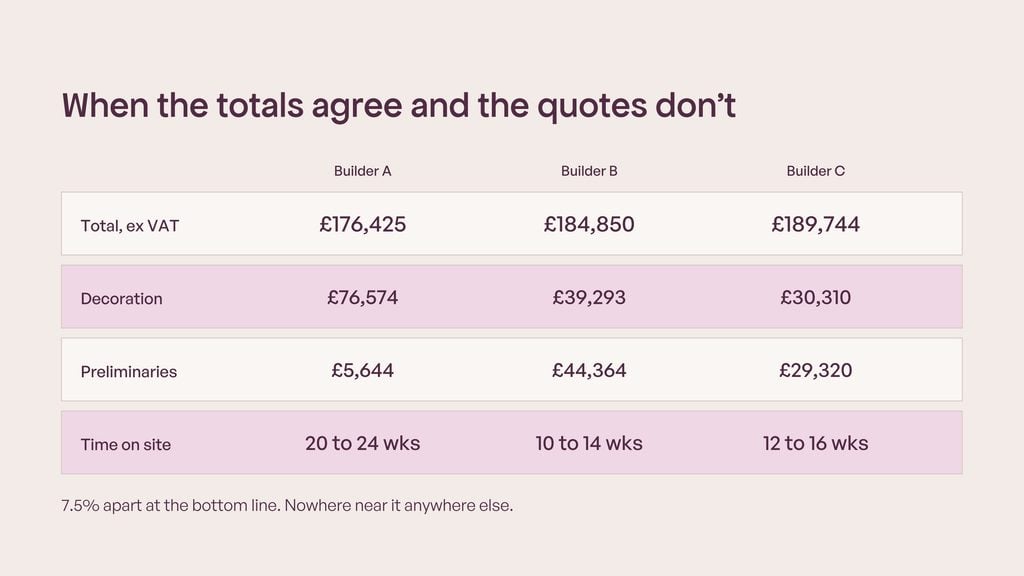
Two quotes 7.5% apart would have looked like agreement. You’d have picked one and moved on. Three quotes 7.5% apart, with those sections underneath, tells you the totals converging is close to a coincidence, and that the real decision is about how each builder intends to run the job.
What does each extra quote buy you?
One quote gives you a price and nothing to judge it against. You don’t know whether it’s high, low or complete. It’s a starting point, not a decision.
Two quotes give you a difference, but no way to interpret it. If they’re 20% apart, that could be scope, rates, overheads or a straightforward mistake. Two numbers can’t tell you which.
Three quotes give you a benchmark. The outlier becomes visible, the middle price establishes what the work costs, and any quote well away from it becomes a question you can put to that builder in writing.
Four quotes give you slightly more confidence and noticeably more admin. We use four occasionally on large or unusual projects where the market is thin, or where one builder is a wildcard the homeowner wants included.
Five or more actively costs you. Builders talk to each other, and a builder who works out he’s one of six will price defensively or not at all. You end up with more quotes of lower quality, and the ones you lose are usually the good ones, because busy builders are the quickest to walk away.
How many quotes should I get for my type of project?
The number moves with the size and risk of the job, not with how nervous you feel about it.
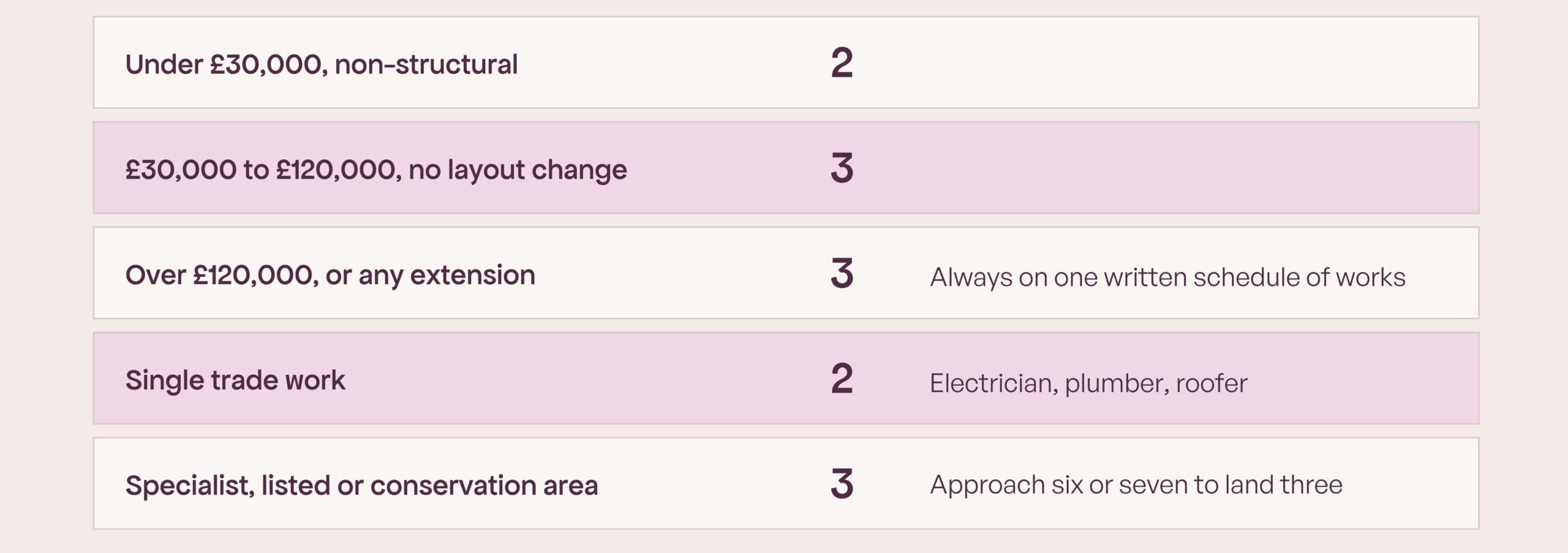
- Under £30,000, non-structural = 2 quotes
- A bathroom, a decorating package, a single-room refit.
- The scope is small enough that a misread is a few hundred pounds rather than a few thousand, and the builder pool is deeper.
- £30,000 to £120,000, no layout changes = 3 quotes
- This is the standard renovation band and the one where missing scope does the most damage.
- Over £120,000, or any extension = 3 quotes
- Every one of them should be pricing on the same written schedule of works.
- At this level the quotes are long enough that comparing them properly is a day’s work, and a fourth adds more to that day than it adds to the decision.
- Single trade work = 2 quotes
- An electrician, a plumber, a roofer.
- There’s less to misread.
- Specialist or unusual work = 3 quotes
- Three, and expect to approach six or seven builders to get them.
- Basements, listed buildings, conservation areas and structural glazing all have smaller pools, and a builder who isn’t right for the work will often tell you so, which is useful in itself.
Does the number of quotes matter more than what’s in them?
No. And this is where most advice on this question stops too early.
Three quotes on three different versions of your project is worse than two quotes on the same one, because it gives you false confidence. You’ve done the recommended thing, you’ve got your three numbers, and you still have no idea what you’re comparing.
Without a written scope, we’ve seen the same renovation quoted at £6,000 and at £22,000. At that point the number of quotes is irrelevant. You aren’t comparing builders, you’re comparing guesses.
Quotes only become comparable when every builder prices the same written scope.
That’s a schedule of works: a line by line description of the job, with the specification, who supplies what, and the unknowns held as provisional sums or prime cost sums.
Even then, a written scope doesn’t make quotes identical. Both projects above had one, and the spreads were still wide. What it does is tell you the gap is real rather than a misunderstanding, and that’s a question you can put to a builder. There’s more on the mechanics in why builders’ quotes are so different for the same job and how to compare two builders’ quotes fairly.
One more thing worth setting yourself. On a project in E8, one builder inserted six of his own provisional sums, for structural works, a chimney breast, an engineer, floor preparation, a consumer unit and a new boiler. They came to £13,020, about 16% of his total, and every figure was his own guess. The other two held the same items at nil. Set one common figure for each unknown and give it to all three, or the allowances will drive the difference between the quotes rather than the work.
What if the third quote is one you found yourself?
Homeowners often get two builders pricing properly and add a third from a recommendation. It’s a reasonable instinct, and it’s worth doing carefully, because a builder who hasn’t priced the same document isn’t a third quote. He’s a separate conversation.
On an NW10 rear extension and loft in June, the homeowner brought in their own builder alongside two of ours. His quote came in at £128,100 against £178,000 and £215,106. A £50,000 saving, on the face of it.
Reading his exclusions changed the picture. He’d left out:
- Internal and external decorating,
- Flooring finishes
- Cornicing.
- Kitchen floor tiling sat outside the price as an optional £2,100 provisional sum.
- Renewing the existing floor build-up was a separate £5,470 to £7,670. Underfloor heating was a £3,290 extra.
The other two carried floor finishes on a £60 per m² supply allowance as standard.
The third quote was genuinely useful here. Just not in the way it first appeared. It didn’t show that the others were expensive. It showed what a quote looks like when nobody has written the scope down.
We’ve written separately about what a word of mouth recommendation is actually worth and how to tell when a builder is good rather than just friendly.
How to get three quotes worth having
1. Write the scope before you approach anyone
One document, priced by all three. Without it you’re not comparing builders, you’re collecting opinions. If you’re not writing it yourself, this is what the schedule of works exists for.
2. Approach more builders than you need quotes from
Expect roughly half to drop out. To land three quotes, approach five or six. On specialist work, approach seven.
3. Get them all on site, ideally on the same day
Quotes priced off drawings alone come back with the widest spread, because every builder is guessing at access, storage, parking and the state of what’s behind the plaster. Same day visits also give you a natural deadline.
4. Set the provisional sums yourself
Decide one figure for each unknown and issue it to all three. Otherwise each builder guesses, and you end up comparing their guesses instead of their work.
5. Level everything in writing
If one builder raises something on site, put it to the other two before they price. Anything that changes the job for one changes it for all three.
6. Read the exclusions before the totals
Every real quote excludes something. The most expensive exclusion is the one nobody wrote down. Ask all three the same question in writing: please list everything not covered by this price.
Should I tell builders how many quotes I’m getting?
Yes, and tell them honestly. Three is a number builders respect, because it signals a serious homeowner running a fair process. It also tells them the price needs to be competitive.
What you never share is the figures. Share the scope, never the numbers. Showing a builder a rival’s total invites him to price to a target rather than to the work, and the difference usually comes back later as a variation. If you want a builder to revisit a section, name the section and ask him to explain his allowance.
There’s more on why that matters in why the cheapest quote is usually the most expensive in the end.
Common questions
Is three quotes a legal requirement? No. There’s no legal minimum for private residential work. Three is a working convention, and it’s a good one, but nothing obliges you. Insurers and lenders sometimes ask for multiple quotes on reinstatement work, so check the wording if you’re claiming.
Is it rude to get three quotes? Not at all. Builders expect it and most will ask how many others are pricing. What annoys builders isn’t competition, it’s being asked to price a project that was never properly defined, or being used to benchmark a builder the homeowner had already chosen.
How long should I give builders to quote? Two to three weeks for a full renovation. One week for a bathroom or single trade work. Less than that and you’ll get a rushed number with wide margins built in.
What if I only get two quotes back? Work with them, but level them properly first. List what each one excludes, add the missing items into the column where they’re absent using the other builder’s price, and compare only once both cover the same scope. Then treat the result as a comparison rather than a benchmark.
Should all three builders be recommendations? Ideally at least one comes from outside your network. Recommendations tell you a builder did good work on someone else’s project, which isn’t the same as being right for yours. A builder who is excellent on bathrooms may never have managed a structural opening.
How many builders should I approach to get three quotes? Five or six for standard renovation work. Seven for specialist, listed or conservation area projects. Expect roughly half to decline or go quiet.
Do more quotes get me a better price? Up to three, yes, because competitive tension is doing real work on your behalf. Beyond four it usually costs you, because the builders you most want start declining and you’re left choosing between the ones who didn’t.
Should I get three quotes for a bathroom? Two is usually enough under £30,000. If the bathroom involves moving soil pipes, structural work or a wet room tank, go to three.
If two quotes are close, do I still need a third? Yes, and the SW5 flat is why. Three totals within 7.5% of each other hid a decoration section ranging from £30,310 to £76,574 and programmes from 10 weeks to 24. Close totals are not the same as agreement.
Tags
Renovate the savvy way
- Simplified process with support throughout
- Pay the right price for proven Pagers
- Transparent pricing & timelines
SHARE THIS ARTICLE