Back to blog
Should decorating and flooring be in the quote?
Yes, almost always. Find out what you should expect to be included, and what shouldn’t.
Decorating, yes, almost always. It’s the trade that finishes everyone else’s work, and a quote that stops at “ready for decoration” leaves you with bare plaster, making good that nobody priced and a decorator to find in the last week.
Flooring depends on the floor. Hard floors, meaning engineered wood, tiles, vinyl and LVT, belong in the builder’s price, or at the very least the preparation beneath them does, because the subfloor is his work and the two can’t be separated when something goes wrong. Carpet is the one it’s reasonable to buy separately, from a specialist who supplies and fits it, as long as the builder’s quote says exactly what state he’ll leave the floor in.
These are also two of the trades most often left out of a quote without anyone noticing. On a W3 house renovation this summer, one builder priced the flooring at £9,748 and the other didn’t price it at all. The second quote looked 8.4% cheaper. With the flooring added back, it was the dearer of the two.
Why decorating and flooring go missing from quotes
Anything at the end of the programme is the easiest thing to trim when a builder wants his number to land, and the easiest thing to leave vague when he’s pricing from a site visit rather than a written scope.
They’re also full of decisions you haven’t made yet. Paint colours, sheen, wallpaper, wood or tile or carpet, which room gets what. A builder faced with an undecided floor can guess, price a rate per square metre, or write “by others”. All three are common, and no two of them compare.
And they’re often subcontracted. Plenty of builders don’t employ their own decorators or floor fitters. Some price those trades in with a margin, others exclude them so they aren’t pricing somebody else’s work. Neither is wrong, but you need to know which you’ve got.
Four examples from recent projects:
- On an NW10 extension and loft, a quote the homeowner found independently excluded “internal/external decorating, flooring finishes and decorative features”. Kitchen floor tiling was an optional £2,100 on top, and renewing the existing floor another £5,470 to £7,670.
- On a W14 flat, the quote excluded the flooring fit, to be charged per square metre, and the electrics, charged per point. The £64,041 total was never going to be the final figure.
- On a W11 flat, 80m² of flooring sat inside a £31,940 joinery line, alongside the doors, the cornice and the wardrobes. It was priced, but you’d only know if you read the line.
- On an SW2 bathroom in September, one builder included trade-mixed paint and the other left it for the homeowner to buy.
What the wording in your quote actually means
Most of the trouble sits in a handful of stock phrases. Each is a normal thing for a builder to write. Each also means the work isn’t finished.
- “Prepare for decoration” or “ready for decoration”: Plastered, filled and made good. Not painted. You’ll need a decorator, and new plaster has to dry before anyone can start.
- “Mist coat to new plaster”: One thinned coat to seal the surface. From the doorway the walls look done. They aren’t, and a mist coat on its own won’t take a wipe.
- “Make good only”: Holes filled and damaged patches repaired, not a new surface. On an SW11 bathroom this summer, one quote carried a full 3mm skim to the walls and ceiling at £740.56. The other said “make good only”, with a note that rebuilding walls after the tiles came off would be charged extra.
- “Decoration to new work only”: The walls and ceilings the builder touched. Not the hallway that’s been scuffed by twelve weeks of trades, or the bedroom next to the new steel with a fresh crack across its ceiling.
- “Client to supply paint”: The labour is priced, the paint isn’t. On an NW8 flat this summer the line read “primer and undercoat included, top coat supplied by you”. You’ll be choosing colours, working out quantities and getting it to site before the decorator needs it.
- “Floor finishes by others” or “floors left ready for finishes”: The builder stops at the subfloor. Ask what “ready” means: level to what tolerance, and dry to what reading.
- “Flooring at £X per m², area to be confirmed”: A rate across an estimate. Fine, as long as every builder prices the same area.
- “Carpets by others”: Perfectly normal, check who takes up the old carpet, who deals with squeaking boards, and who trims the doors afterwards.
If one quote carries any of these and another doesn’t, add the missing work back before you compare them. There’s a step by step method in how do I compare two builders’ quotes fairly and more on reading the small print in what should be included in a builder’s quote.
Should decorating be in the builder’s price?
Yes, in almost every case, for four reasons.
1. Decorating is where the making good lands.
Every trade leaves marks. Chased walls, filled holes, cracks from steels going in, scuffs from ladders. A decorator working for the builder deals with those as part of his scope. One you bring in afterwards will either price them as extras or paint over them.
2. It keeps snagging simple.
If the builder decorates, a crack in the finished ceiling is his to fix. If your own decorator has painted over his plaster, the first question anyone asks is whose crack it is.
3. The drying time sits in his programme.
Dulux advises that new plaster can take up to four weeks to dry completely. If decorating is in the builder’s price, that wait is planned around. If it isn’t, you’re moving into bare plaster and booking a decorator for a date nobody can confirm.
4. The saving is small next to the risk.
Across 13 quotes that show decoration as its own line, it came to between 3% and 13% of the total, with a median of about 6%. Splitting it off saves the builder’s margin on that slice and hands you every problem above.
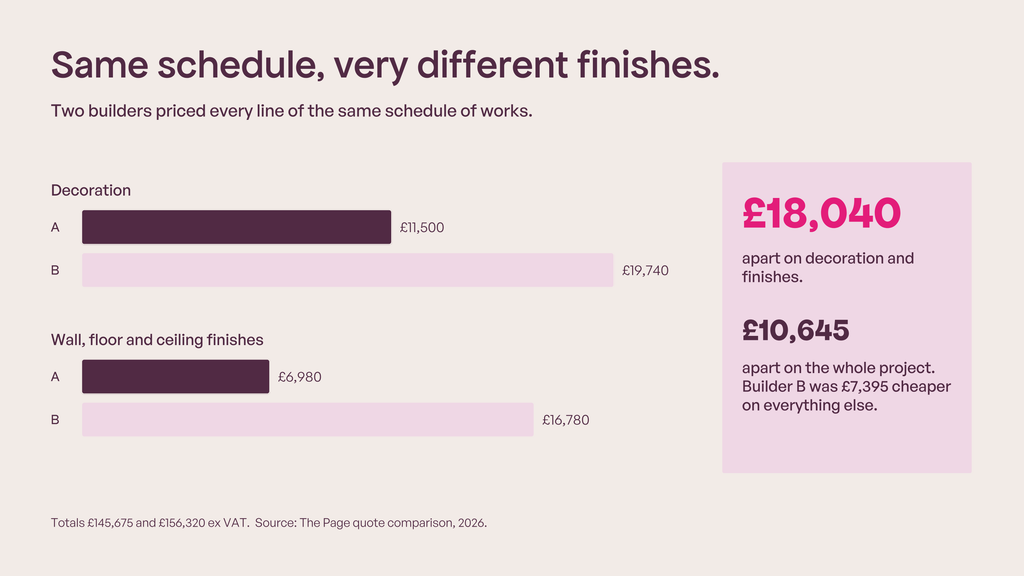
What changes between quotes is the standard. On an NW3 flat renovation with a new dormer this spring:
- Two builders priced the same schedule of works.
- Decoration came back at £11,500 and £19,740.
- Wall, floor and ceiling finishes at £6,980 and £16,780.
- Across those two sections the builders were £18,040 apart.
- Across the whole project they were only £10,645 apart, because the builder who was dearer on the finishes was £7,395 cheaper on everything else.
When the finishes are priced that differently, it’s usually because the schedule described the rooms rather than the standard. “Decorate throughout” means two coats to one builder and three to another. It includes woodwork and radiators for one and not the other. So write the standard down:
- which surfaces: walls, ceilings, woodwork, doors, radiators
- how many coats after the mist coat
- which paint range and finish, or that you’re supplying it
- whether it covers rooms the renovation doesn’t otherwise touch, including the hall and stairs
Writing it down won’t make the prices match.
- On an SE23 master suite in August, three builders priced the same written line, a mist coat plus two finish coats to 90m² of wall, at £23, £28.30 and £45 per m².
- On an SE9 project in June, identical measured decoration came back at £1,107, £1,500 and £1,949.
What a written standard does is tell you the gap is in the rate rather than the scope, and that’s a question you can put to a builder.
When you might take it out.
- If you want to decorate yourself to save money, that’s fine.
- Keep the mist coat in the builder’s price, walk the rooms with him and agree the snagging before you pick up a roller, and accept that the finish is then yours.
- The same applies if you’re using a specialist for lime paint, polished plaster or wallpaper.
- Take the finish out, but leave the preparation in.
Should flooring be in the builder’s price?
Split it by floor type.
Hard floors: in the builder’s price. Engineered and solid wood, parquet, tiles, stone, vinyl and LVT all depend on what’s underneath them. The subfloor has to be flat, sound and dry, and on a renovation that’s the builder’s work: lifting old floors, replacing boards, overlaying with ply, pouring a screed or a levelling compound. When the floor and the subfloor come from the same contractor, a problem has one owner.
Much of the cost is under the floor rather than on it. On an NW8 flat this summer, both builders ended up pricing a full replacement: lift the old floor and skirting, sister the joists, add noggings, level, then fit the new floor and skirting. That came to £9,500 in one quote and £10,400 in the other, with the homeowner supplying the boards. An overlay on the existing floor was priced at £5,000.
In a flat, check what goes under the finish as well. On an E14 flat this summer, one builder self-levelled the floors and tiled. The other added a 6mm acoustic and thermal insulation layer under the tiles first, which suits an upper-floor flat. Only one quote had it.
When the floor and the subfloor come from different contractors, the most common failure is moisture. A new sand and cement screed dries slowly. Guidance in BS 8204-1 works on about a day per millimetre for the first 50mm, and longer beyond that, so a 50mm screed needs around seven weeks before anyone lays on it. Most floor coverings need the surface below 75% relative humidity, and bonded wood floors need it drier still.
Lay engineered oak on a screed that isn’t dry and it will cup or open up within months. The flooring company blames the screed. The builder blames the fitting. You’ve paid both.
If you want to choose and buy the boards yourself, that’s fine. Have the builder fit them, or make him responsible for handing over a floor that’s been moisture tested and signed off before your fitter arrives.
For budgeting, on the W3 house one builder priced subfloor preparation at £40 per m² and fitting the homeowner’s engineered oak at £112 per m², including trims, thresholds and expansion gaps. Across 49m² of ground floor, that’s £7,448 before a single board is bought.
Carpet: fine to buy separately. Carpet is usually bought from a retailer who measures, supplies and fits it for one price, and choosing it is visual enough that most people want to do it themselves. There’s no VAT advantage to putting it through the builder either, which we’ll come to. Just make sure the builder’s quote covers his side of the line. The W3 schedule is a good model: carpet “supplied and installed by others”, and the builder to take up the old floor covering and “secure boarding and eliminate squeaks ready to receive carpet”, priced at £40 per m².
The one thing that line doesn’t mention is the doors. New flooring nearly always changes the floor height. Most carpet fitters won’t trim doors, and a builder who’s already left site will charge to come back and do it.
If you have underfloor heating, there’s one more handover to agree. The system has to be commissioned and the screed brought up to temperature gradually before any floor goes down, and that needs to be somebody’s responsibility rather than an assumption. Check it’s in the price at all, too. On an SW11 bathroom this summer, an electric underfloor heating mat was in one quote and missing from the other.
Should flooring go down before or after decorating?
Hard floors usually go down before the final coats of paint and are protected while the decorator finishes. Carpet goes down last, once the painting is done.
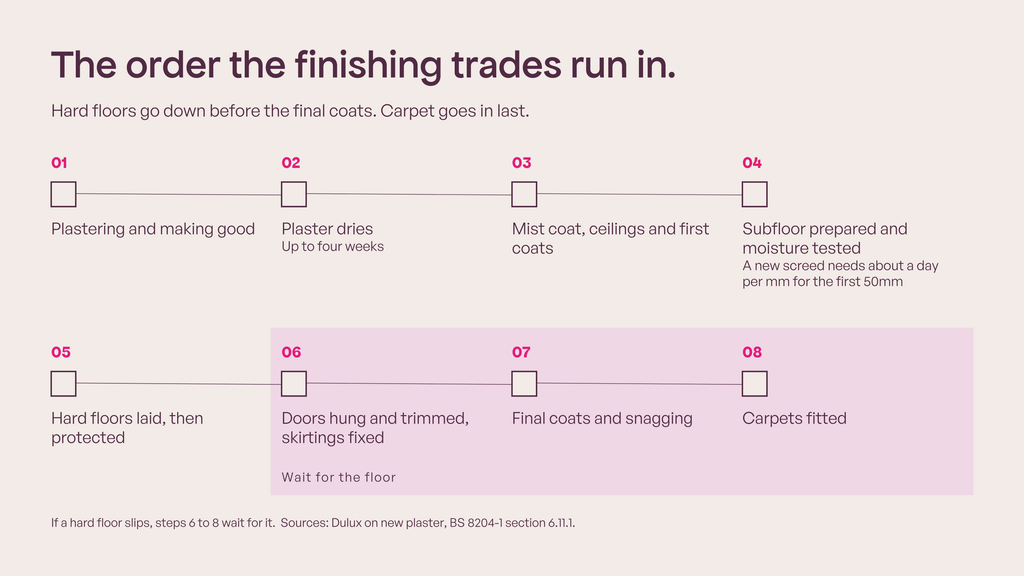
The logic is simple. Paint on a protected oak floor comes off with the protection. Paint on a new carpet doesn’t. Skirtings go on after a hard floor so they sit on the finished surface, then get their last coat with everything else. Doors are hung and trimmed once the finished floor height is known.
It also shows why a late floor holds up everything behind it. If the hard floor slips a week, the doors, the skirtings and the final decoration all slip a week, and the builder’s time on site is running the whole way through.
The VAT point for reduced rate projects
Most renovations are standard rated at 20%, and on those VAT makes no difference to who buys what.
Some qualify for a reduced 5% rate, most commonly where a property has been empty for two years or more, or where you’re changing the number of dwellings. Under section 2.2 of HMRC’s VAT Notice 708, building materials the builder supplies and installs take the same rate as his work. Notice 708 treats maintenance such as redecoration as part of qualifying renovation work, so decorating in the builder’s price is at 5% too.
Flooring splits in two. HMRC’s guidance is explicit that carpets and carpeting material, such as carpet tiles, aren’t building materials, while “all other fixed floor coverings (such as vinyl and parquet)” are. Gripper rods and stair nosings are separately identifiable from the carpet, so they fall outside the exclusion.
Section 7.1.1 of Notice 708 adds that where a builder installs something that isn’t a building material, his installation charge is standard rated too. So carpet is 20% on the goods and 20% on the fitting, whoever you buy it from.
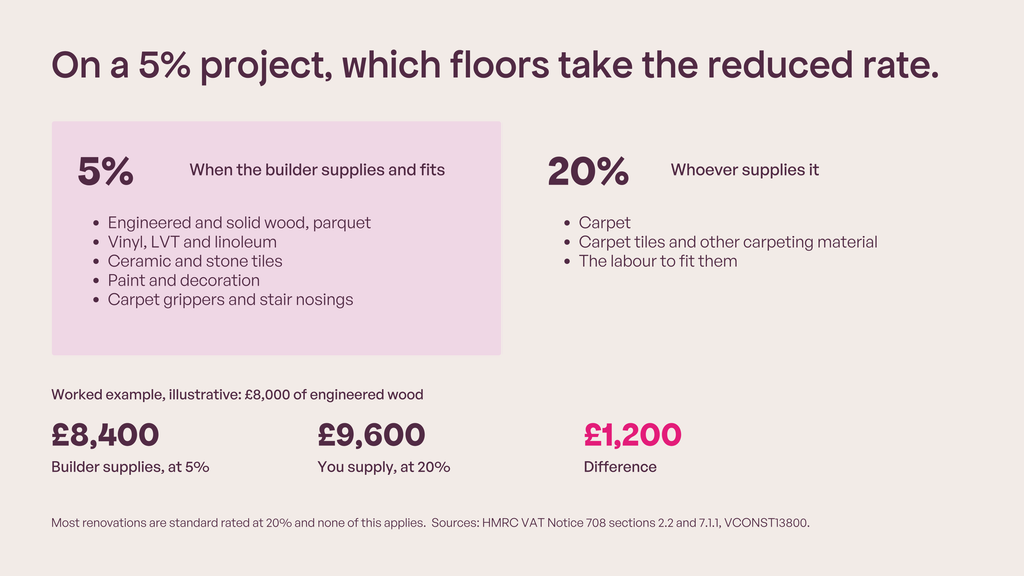
On a 5% project, put the hard floors and the decorating in the builder’s price and buy the carpet wherever suits you. On £8,000 of engineered wood, that’s £400 of VAT through the builder against £1,600 if you buy it yourself.
Why this breaks quote comparison
Across five London tenders we’ve run in 2026, the gap between the lowest and highest quote averaged 12%, and most of it turned out to be scope rather than price. Decorating and flooring are two of the most common reasons.
A quote that stops at “ready for decoration” and one that ends with painted walls are pricing two different projects.
The W3 house is the clearest example this year. Builder B’s £70,800 ex VAT looked £6,500 cheaper than Builder A’s £77,300. But B had priced the flooring section at nothing. A had it at £9,748: preparing 49m² of ground floor, fitting the homeowner’s engineered oak, preparing 35m² upstairs for carpet and fitting new skirting. Add it to B and he comes to £80,548, the dearer of the two.
An NW10 extension and loft went further. A quote the homeowner found independently came in £49,900 below the lowest of ours. It excluded decorating and floor finishes, carried kitchen floor tiling as a £2,100 optional extra and priced renewing the existing floor separately at £5,470 to £7,670. The windows, the kitchen installation and the underfloor heating sat outside it too.
There’s more on how that happens in why is the cheapest quote usually the most expensive in the end, and on where the gaps come from in why builders’ quotes are so different.
The fix is to decide before you tender, and tell every builder the same thing.
If you haven’t chosen the floors or the paint yet
Most people haven’t at this stage. Use allowances rather than leaving the lines blank.
For flooring, a prime cost sum per square metre works well. On the NW10 extension, floor finishes were carried at £60 per m² for the finish itself, over measured areas, while the homeowner chose. Every builder prices the same allowance plus his own labour to fit it, and the figure is adjusted against the real invoice later. For paint, name a range and a finish, or state that you’ll supply it. Either works, as long as everyone is told the same thing.
What doesn’t work is letting each builder decide. One allows for laminate because he’s pricing it like a rental, another allows for oak because he’s seen your mood board, and neither total tells you anything about the builder. It’s the same logic we set out for the kitchen units and the bathroom suite.
What to settle before anyone quotes
Ten things, all easy to write down now and much harder to agree once the builder is on site.
- Whether decoration is in the price, and to what standard: which surfaces, how many coats, which paint range.
- Whether decoration covers rooms the renovation doesn’t otherwise touch, including the hall and stairs.
- Who supplies the paint.
- Which floors are hard and which are carpet, room by room, with measured areas.
- Who supplies and who fits each floor, or the allowance per square metre if you haven’t chosen.
- Who prepares the subfloor, and who takes and signs off the moisture reading before anything is laid.
- Whether skirtings come off before a hard floor goes down.
- Who trims the doors and fits the thresholds once the new floors are in.
- Who protects finished floors while other trades are still working.
- Whether the project is standard rated or reduced rated for VAT.
Number six is the one to be firm about. A floor laid on a wet screed fails slowly, well after everyone has left, and the argument about whose fault it is starts from nothing unless the reading was recorded.
All of this belongs in your schedule of works, room by room, so every builder prices the same line.
Common questions
Do builders’ quotes usually include decorating? Often, but not always. In our pricing data, one in six quotes left paint or decoration to the homeowner. The wording matters as much as the line: “prepare for decoration” and “mist coat to new plaster” both mean the walls won’t be finished. If the quote doesn’t say which surfaces and how many coats, it hasn’t told you what you’re getting.
Does “ready for decoration” include painting? No. It means plastered, filled and made good, ready for a decorator to start. Painting is extra.
Should I buy my own flooring? You can buy it, but have the builder fit hard floors, or at least take responsibility for the subfloor they go on. Carpet is fine to buy and have fitted by a specialist. On a project that qualifies for 5% VAT, hard floors are cheaper through the builder, because the reduced rate only applies to what he supplies and installs.
Should flooring go down before or after painting? Hard floors usually go down before the final coats and are protected while the decorator finishes. Carpet goes down last, once the painting is done.
How long does a new screed need before flooring goes down? Guidance in BS 8204-1 works on about a day per millimetre for the first 50mm, and longer beyond that, so a 50mm screed needs around seven weeks. Most floor coverings need the surface below 75% relative humidity, and bonded wood floors need it drier still. Ask for the reading before anything is laid.
Can I get 5% VAT on carpets? No. HMRC excludes carpets and carpeting material from building materials, so carpet is 20% whoever supplies it, and the fitting is standard rated too. Wood, vinyl, tiles and other fixed floor coverings do take the reduced rate on a qualifying project when the builder supplies and fits them.
Can I do the decorating myself to save money? Yes. Keep the mist coat in the builder’s price, agree the snagging with him before you start, and accept that the finish is then your responsibility rather than his.
Who trims the doors after new flooring goes down? Whoever you’ve agreed will. Most carpet fitters won’t, and a builder who’s already left site will charge to come back. Put it in the builder’s scope.
Tags
Renovate the savvy way
- Simplified process with support throughout
- Pay the right price for proven Pagers
- Transparent pricing & timelines
SHARE THIS ARTICLE