Back to blog
What is a prime cost sum and how much should I allow?
A prime sum (or PC sum) is the allowance within a quote for fixtures, fittings, or materials which haven’t been decided or bought yet.
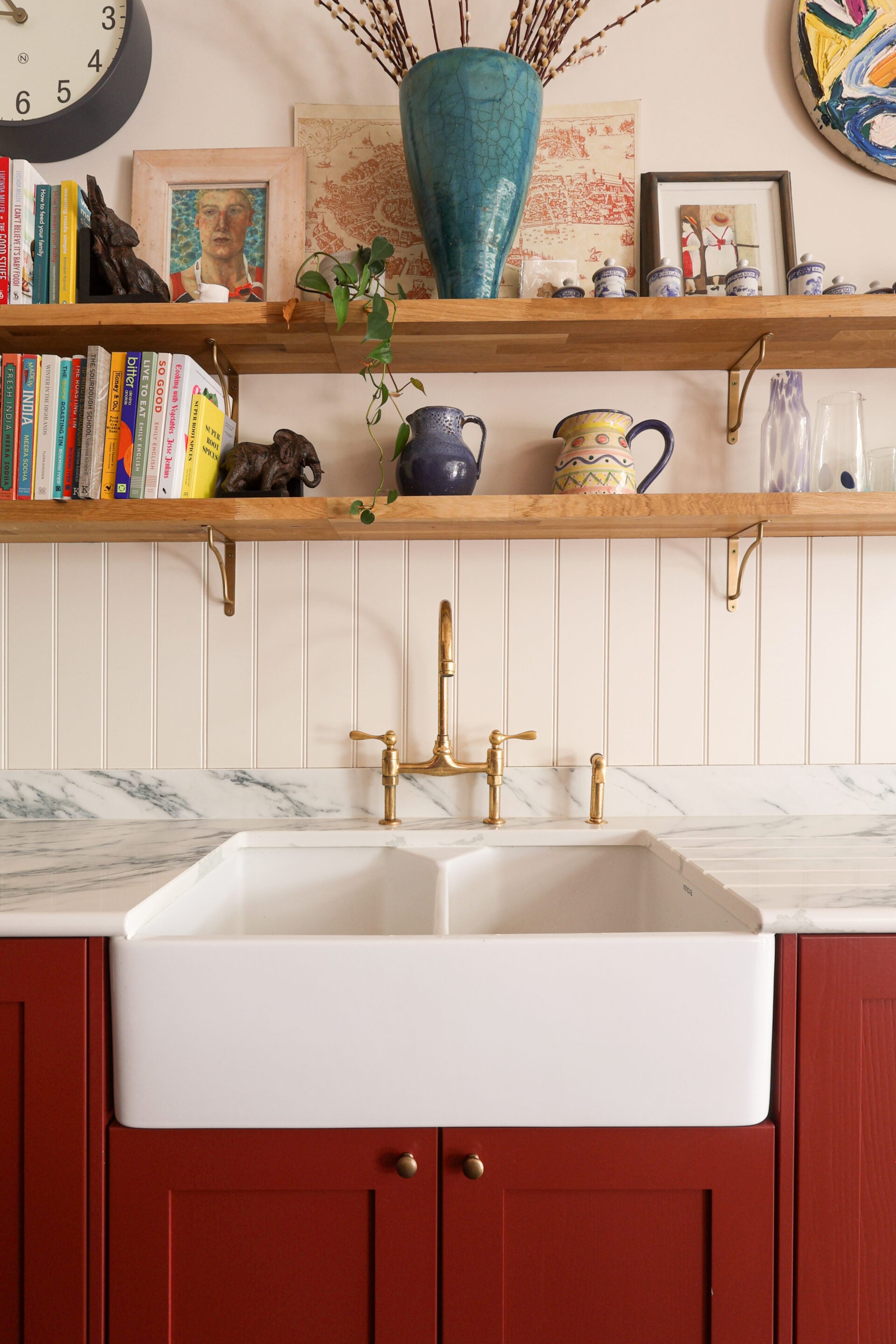
A prime cost sum, almost always shortened to PC sum, is an allowance in a builder’s quote for the supply of an item you haven’t chosen yet, such as a kitchen, sanitaryware, tiles or ironmongery. It covers the cost of the goods only. Labour to install them is priced separately, VAT sits on top, and the builder adds a percentage for attendance and profit.
As a starting point on a London home renovation, allow:
- £14,000 to £20,000 for a kitchen,
- £2,200 to £3,500 per bathroom for sanitaryware,
- £25 to £60 per square metre for tiles,
- all supply only and excluding VAT.
The PC sum is the friendliest-looking line in a builder’s quote and the one most likely to ruin your budget, because it’s the only number in the document that depends entirely on decisions you haven’t made yet.
Every other line in a quote is the builder’s estimate of the building cost. A PC sum is the builder’s estimate of your taste, and they have very little to go on. Write £3,500 for a bathroom and it either covers the whole thing comfortably or it covers the taps, depending on what you fall in love with three months from now.
This is the fourth piece in a series on reading a builder’s quote. If you haven’t read them, the earlier three cover what should be included in a quote, preliminaries, and provisional sums, which are a different thing to PC sums despite constantly being confused with them.
What a PC sum actually covers, and what it doesn’t
The critical thing, and the thing that catches nearly everyone, is that a PC sum is supply only.
A £14,000 kitchen PC sum is not a £14,000 kitchen. It’s £14,000 of cabinetry and worktop arriving on a lorry. Sitting outside that number, in separate lines you need to find and add up, are these:
- The labour to install it: On a recent tender we ran, a £14,000 kitchen PC sum sat alongside £4,200 for kitchen installation and connection.
- Attendance and profit: The builder’s charge for receiving, unloading, storing, protecting and coordinating an item they didn’t buy.
- VAT: 20%, unless your project qualifies for a reduced rate.
- Everything peripheral: Appliances are frequently excluded from a kitchen PC sum. So are sinks, taps, handles and lighting.
So the honest value on that £14,000 kitchen is closer to £14,000 plus £4,200 installation plus roughly £1,750 attendance and profit, which is £19,950 before VAT and £23,940 with it. That’s the number to hold in your head, not the £14,000.
The distinction from a provisional sum matters here. A provisional sum is an allowance for the work that hasn’t been designed. A PC sum is an allowance for goods you haven’t picked. The first is usually resolved by a survey, the second is resolved by you.
Attendance and profit: the percentage nobody mentions
When a builder handles an item covered by a PC sum, they charge for doing so. It’s entirely legitimate, since somebody has to take delivery of nine hundred kilos of cabinetry up four flights of stairs, store it somewhere dry, protect it, and sequence the fitter.
On our tenders that charge runs at 12.5% of the PC value. On a recent SW5 mansion flat renovation we priced at £209,341, the kitchen PC sum was £20,000 and attendance and profit on it came to £2,500.
Attendance and profit moves pro rata with the PC value. If you upgrade that £20,000 kitchen to £26,000, you don’t pay £6,000 more. You pay £6,000 plus 12.5%, which is £6,750, before VAT takes it to £8,100.
Worth knowing, too, that a declared attendance percentage is the transparent version of something that happens either way. Industry guidance notes that fitters commonly mark sanitaryware up by 20 to 40% when they supply it themselves. A PC sum with a stated 12.5% attendance is not the expensive option, it’s the visible one.
How much should I allow?
Here’s what we actually put into London tenders.
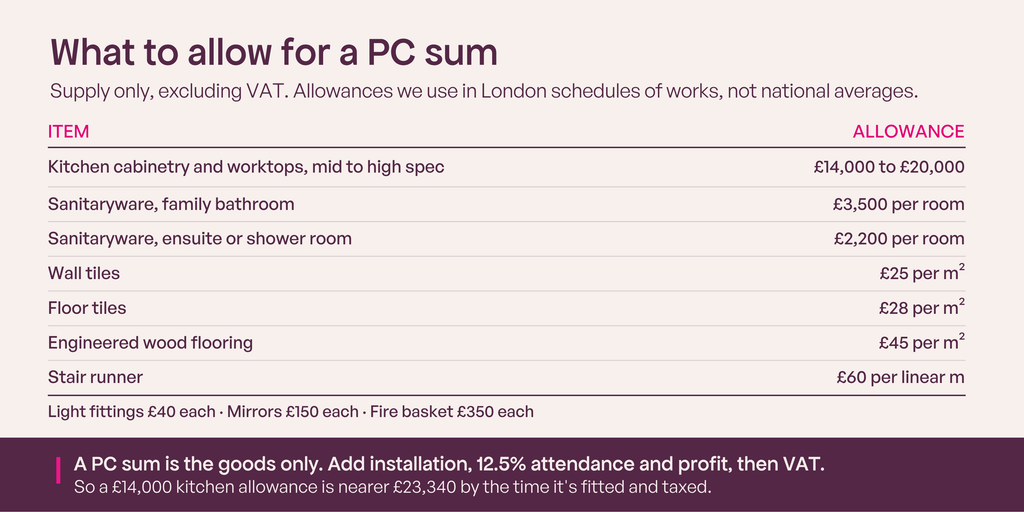
Those are working numbers for a decent London specification, and they’re deliberately not the cheapest possible. Set against the wider market they sit where you’d expect. A mid-range sanitaryware suite from an established brand typically runs £1,000 to £3,000, so £3,500 buys a family bathroom comfortably. Go designer and sanitaryware alone can reach £5,000 to £10,000, which is exactly how a £3,500 allowance becomes a £6,000 overspend without anybody doing anything wrong.
Budget tiles start around £15 to £25 per square metre, mid-range ceramic and porcelain runs £30 to £60, and large-format or natural stone reaches £80 to £150. A bathroom typically needs 20 to 30 square metres across walls and floor, so the difference between a £25 allowance and a £90 stone is roughly £1,600 on one room.
London and the South East run 20 to 35% above the national average, so national cost guides will read low. And if you have already chosen something, it should not be a PC sum at all. It should be a fixed price against a specific product code.
Where PC sums hide
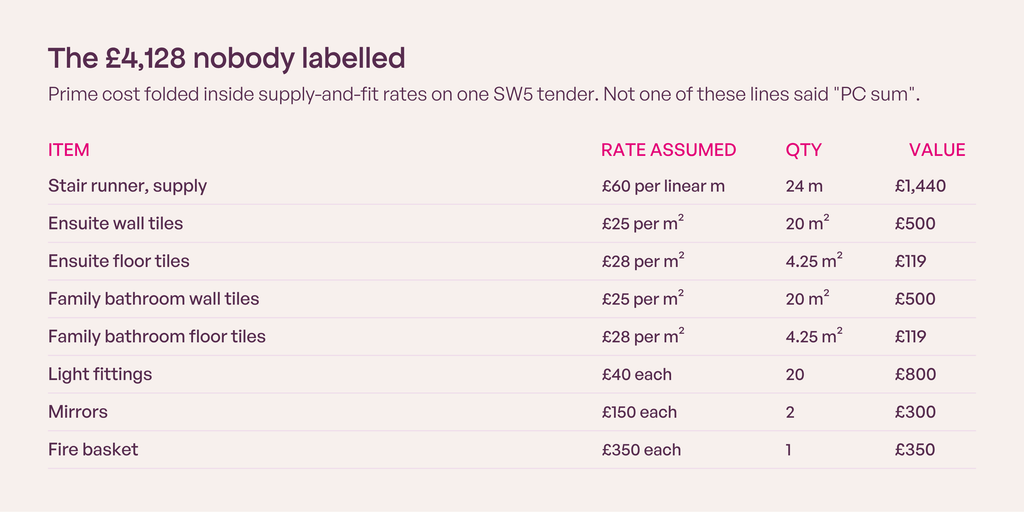
On that same SW5 tender we found another £4,128 of prime cost that wasn’t labelled as an allowance anywhere, because it was folded inside supply-and-fit rates (this is when the builder will purchase the materials and fit it).
Take the ensuite wall tiling. It’s priced as a single rate per square metre covering supply and fitting. Inside that rate sits an assumption of £25 per square metre for the tile itself, with the balance being adhesive, grout and the tiler’s time. That £25 is a prime cost in all but name, since it’s an allowance for a product nobody has chosen. But it never appears as one, so if you total up every line marked “PC sum” in the quote, you miss it.
Then you choose a £90 per square metre stone, and the rate was never going to hold.
Across that one tender there were nine of them:
Setting your allowance in three steps
1. Go and look at things before you fix the number: An afternoon in two showrooms will tell you more about whether £3,500 is generous or not enough.
2. Set the allowance at what you’d actually be happy with, not the minimum: A PC sum set low doesn’t save money, it defers the reckoning to a point where you have less leverage and no ability to compare builders on it. And since the contractor carries no risk for whether an allowance was adequate, a low PC sum costs them nothing and you everything.
3. Fix the same figure across every builder: This is the one homeowners skip, and it’s the one that matters most. If three builders each guess their own kitchen allowance, their totals are not comparable in any meaningful sense. When all three price an identical £16,000 kitchen PC sum, the differences between their quotes are real.
Four questions to ask about every PC sum
- Is this supply only, and what’s the installation line?
- What percentage is attendance and profit, and does it move if the item does?
- What’s specifically excluded?
- What rates are assumed inside the measured work?
If a builder can answer all four in a couple of minutes, the allowances in their quote have been thought about. If they can’t, the quote contains a set of guesses you’ll be paying to correct.
Fewer allowances, better decisions
The best PC sum is the one you replaced with a real price before the tender went out.
Every item you choose before builders quote converts a range into a number, removes an argument from month four, and makes the three returns genuinely comparable. That’s not always possible, and there’s nothing wrong with a considered PC sum for something you honestly haven’t decided. But the tiles usually could have been chosen.
Tags
Renovate the savvy way
- Simplified process with support throughout
- Pay the right price for proven Pagers
- Transparent pricing & timelines
SHARE THIS ARTICLE