Back to blog
What are preliminaries and why are they so expensive?
Preliminaries are the cost of running a building site, typically 10 to 15%. Here’s what’s inside that line and why it costs what it does.
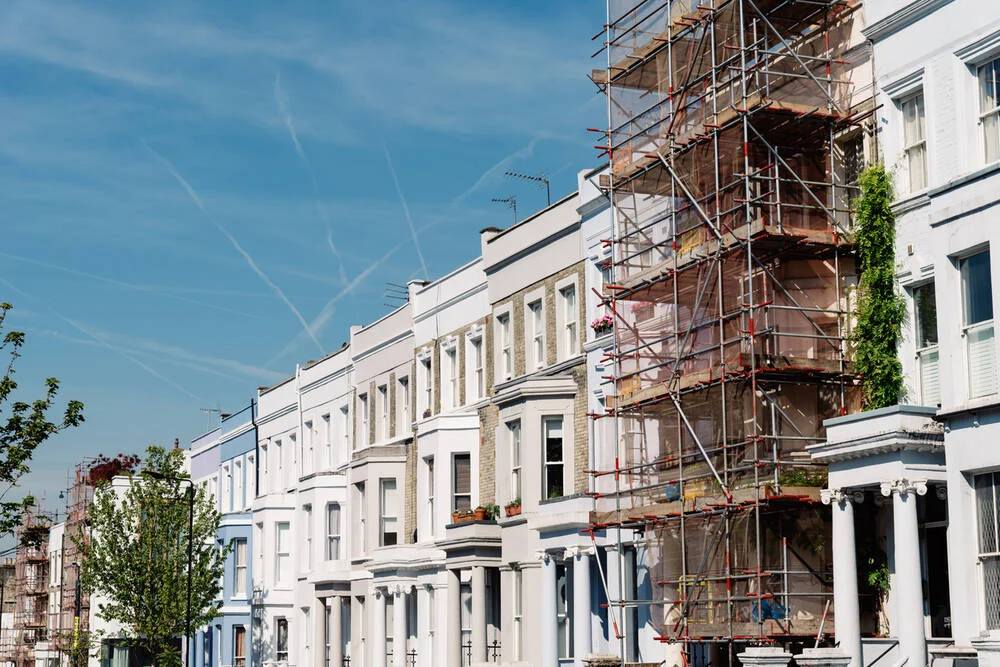
Preliminaries, usually shortened to prelims, are the project-wide costs of running a building site. They cover site management, scaffolding, access, welfare facilities, skips, waste removal, protection, permits, insurances, and the final clean. On a London refurbishment they typically account for 10 to 15% of the total quote, and feel expensive because most of them are time-related rather than work-related, which means they’re driven by how long your builder is on site rather than by how much building actually gets done.
Almost every homeowner asks the same question about the same line, a number somewhere between £5,000 – £20,000 labelled “preliminaries”, and it isn’t obvious what any of it buys.
The instinct is that it’s builders adding padding to the quote, which it sometimes is. However, far more often than not, it’s the most honest part of the document, because a builder who has priced prelims properly has thought carefully about how long they’ll be on your site and what it’ll cost them to be there, while a builder who has left the line blank hasn’t stopped needing scaffolding, they’ve just decided not to mention it.
If you haven’t read what should be included in a builder’s quote, our advice post covers the whole quote document; and what to expect.
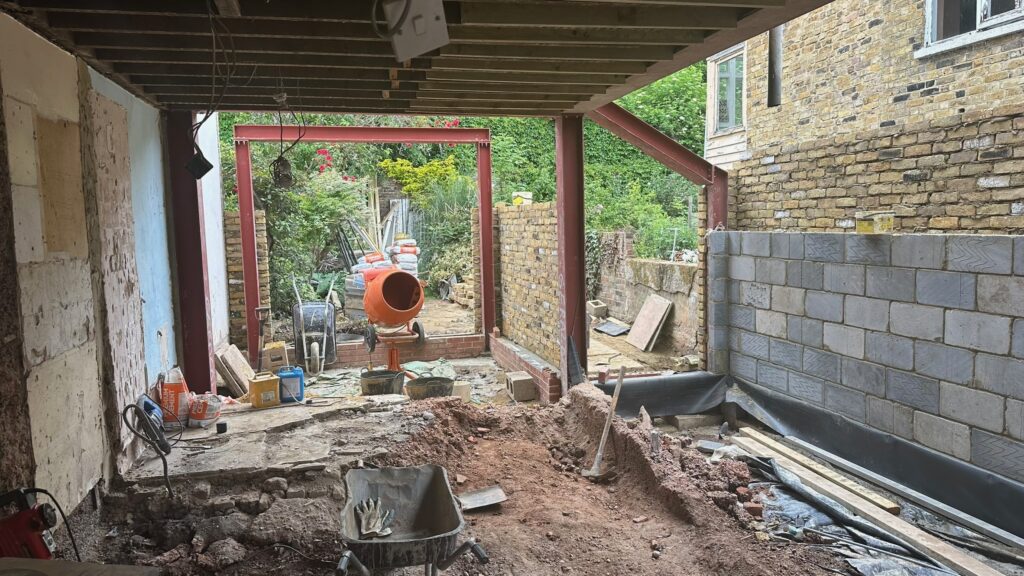
What’s actually inside preliminaries?
Preliminaries have a formal definition; under the RICS New Rules of Measurement, the measurement standard most quantity surveyors work to, prelims are Work Section 1, and they’re deliberately priced separately from the trades so that the cost of running the site is visible rather than buried inside everybody’s rates.
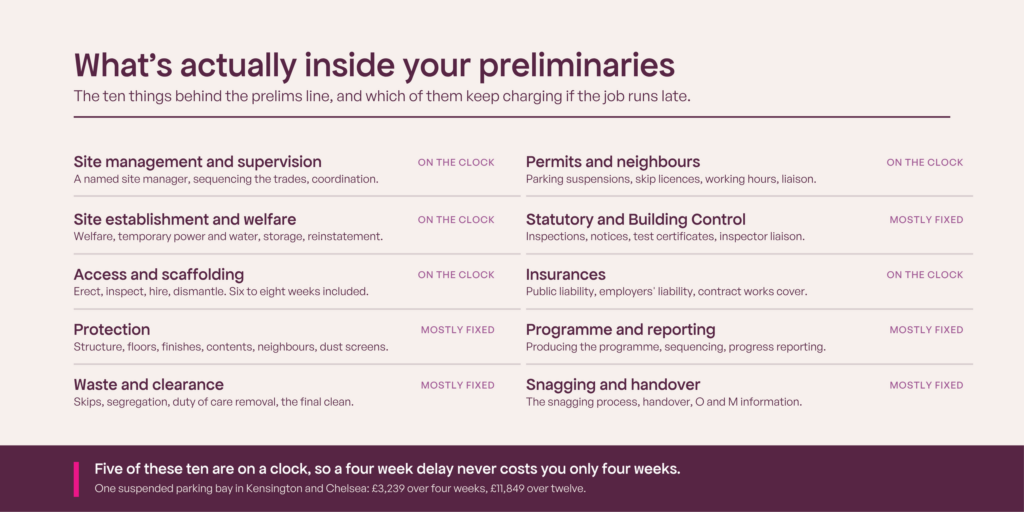
What it actually covers
- Site management and supervisio
- A named site manager or working foreman, day to day coordination, sequencing the trades, attending site meetings
- Site establishment and welfare
- Welfare facilities, temporary power and water, storage, signage, and reinstating whatever space was used
- Access and scaffolding
- Scaffold, towers, edge protection, erection, inspection, hire for the full period, and dismantling
- Protection
- Protecting the retained structure, floors, finishes, your contents and the neighbouring property, plus dust screening
- Waste and clearance
- Skips, waste segregation and removal under duty of care, regular clearance, builder’s clean and final clear
- Permits and neighbours
- Parking suspensions, skip licences, delivery and working hours management, neighbour liaison
- Statutory and Building Control
- Arranging inspections, providing notices and test certificates, liaising with the approved inspector
- Insurances
- Public liability, employers’ liability and contract works or all risks cover
- Programme and reporting
- Producing and maintaining the programme, sequencing, progress reporting
- Snagging and handover
- The snagging process, handover, and issuing the operation and maintenance information
Read that list and the number starts to make more sense, because none of those ten things is optional and they aren’t something you can photograph at the end!
Why preliminaries cost what they do
1. They’re time-related, so the programme drives the price
This is the single most important thing to understand, and it’s the reason two builders can quote wildly different prelims for identical building work.
Most measured works are volume-related, whereas a site manager costs the same per week whether the week is productive or not, scaffolding accrues hire costs whether anyone climbs it or not, and welfare facilities cost the same on a quiet week as a busy one. So when one builder says four weeks and another says nine for the same schedule of works, they aren’t just quoting different programmes, they’re quoting fundamentally different prelims.
The clearest illustration we’ve found is a single London parking bay. The Royal Borough of Kensington and Chelsea publishes its suspension fees openly, and from 1 April 2026 they run at £82 per space per day for the first five days, £123 per day from day six to day 42, and £164 per day from day 43 onwards, with the escalation designed quite deliberately to discourage long suspensions.
Other boroughs price it differently but the shape is the same, with Waltham Forest charging £100 per bay per day plus a £120 application fee and Islington charging £127 per calendar month for the skip licence alone, separately from the suspension the skip sits in.
Scaffolding behaves the same way, though the mechanism is slightly different. The headline scaffold price usually bundles in an included hire period, most commonly six to eight weeks but sometimes as little as four and sometimes as long as twelve, and the real money sits in the erect and dismantle charge rather than the weekly rate, since that labour and haulage costs the same whether the scaffold stands for one week or eight. Industry guidance is blunt that the included hire period is the single biggest reason two scaffold quotes look different, which is why Checkatrade advises asking for scaffolding to be itemised so you can actually check the duration, the permits and the dismantling.
So if your job overruns, prelims are the part of the price that grows, and they grow faster than the delay itself.
2. They’re largely fixed, which hits smaller projects hardest
A site needs one skip route, one welfare setup, one set of insurances and one site manager whether the project is worth £60,000 or £600,000. Those costs don’t scale down neatly, so the smaller the job, the larger prelims look as a proportion of it. This is why homeowners doing a single-room renovation sometimes see prelims approaching 20% and conclude they’re being fleeced, when in fact they’re simply paying the fixed cost of having a properly run site spread across a smaller number.
3. London is genuinely more expensive, and not by a little
Scaffolding alone runs 20 to 30% higher in London and the South East than in the north. Everything in the capital adds an extra cost on top: controlled parking zones that require a bay suspension as well as a skip permit, restricted access down terraced side returns that turns a two-hour material delivery into a half-day one, pavement licences where scaffold oversails a public footpath, tighter permitted working hours, and neighbours close enough that liaison stops being a courtesy and becomes a line item.
None of that appears in a national cost guide, and all of it lands in prelims.
4. You’re paying for the absence of problems
Prelims only buy you things you only notice when they’re missing. Nobody has ever finished a renovation and admired the dust screening. But the alternative to dust screening is plaster dust through the whole house, and the alternative to proper floor protection is a repolished floor at your expense, and the alternative to a named site manager is five trades arriving in the wrong order and a fortnight lost to rework. Protection, supervision and insurance are all costs incurred so that a much larger cost doesn’t happen, which makes them impossible to appreciate and very easy to cut.
What this looks like in a real tender
Here’s a refurbishment and rear dormer we tendered in north London, where three vetted contractors priced the same schedule of works.
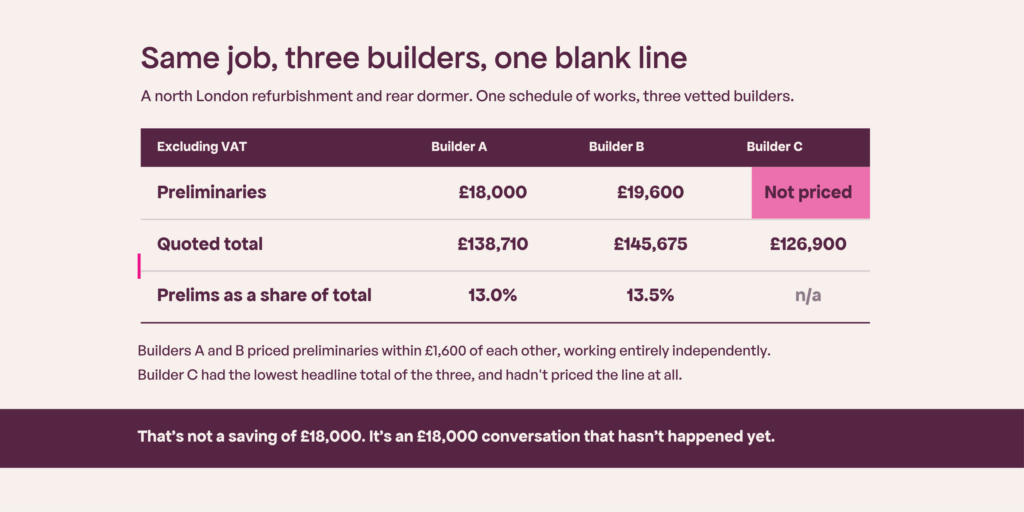
Builders A and B landed within £1,600 of each other on prelims, which is close agreement between two firms working independently and a good sign that both had read the job properly. Builder C, whose headline total was the lowest of the three by some distance, hadn’t priced preliminaries at all.
That’s not a saving of £18,000. It’s an £18,000 conversation that hasn’t happened yet, and it will happen, most likely somewhere around week three when the scaffold arrives.
That’s the entire case for a written Schedule of Works, and it’s the reason our comparison documents show what’s underneath each prelims figure rather than just the figure itself.
Is a low prelims figure a good sign?
Almost never, and this is the part most homeowners get backwards. When you’re comparing quotes, a low prelims line is one of the few numbers where lower is actively worse.
There are only really four explanations for it, and three of them cost you money:
- The builder has a shorter programme: This is a good outcome, and it’s worth confirming and then holding them to it.
- The builder has excluded something: Scaffolding, permits and protection are the usual candidates.
- The cost hasn’t gone anywhere, it’s just moved to your side of the ledger.
- The builder has buried it in their rates: Nothing dishonest about this, but it makes their quote impossible to compare against anyone else’s and impossible to negotiate.
- The builder hasn’t thought about it: Which tells you what site management is going to look like in week six.
Six questions to ask about the prelims line
- How many weeks on site is this priced on?
- What’s the scaffold hire period, and what does an extra week cost?
- How many skips have you allowed, and what size?
- Who’s applying and paying for the parking suspension and skip licence?
- Is the site manager full time or visiting?
- If the programme extends by four weeks, which of these costs move, and by how much?
If a builder can answer all six without hesitating, the prelims line is probably sound even if it’s higher than the others. If they can’t, the number is a placeholder regardless of how low it is.
So, are preliminaries negotiable?
The permits, the insurances, the skips and the scaffold are real third-party costs with invoices attached, and there’s very little room in them. What genuinely moves is the programme, and since prelims are mostly time-related, a shorter programme is the only meaningful lever you have.
A design that’s fully resolved before tender, with the specification fixed and the choices made, produces a shorter and more certain programme than one where the tiles are still being chosen in week five. Every mid-build decision extends the job, and every extension quietly re-runs that parking bay calculation. The other lever is having a reliable scope; a builder pricing a vague scope has to allow for the worst case somewhere, and prelims are where that allowance usually lands.
Before you compare…
- Preliminaries are the clearest example of why builders’ quotes can’t be compared on totals alone. We write a Schedule of Works, run the tender with three vetted Pagers, and produce a comparison document that shows what sits underneath each prelims figure.
Tags
Renovate the savvy way
- Simplified process with support throughout
- Pay the right price with proven Pagers
- Transparent pricing & timelines
SHARE THIS ARTICLE