Back to blog
What is a provisional sum?
Preliminaries are the cost of running a building site, typically 10 to 15%. Here’s what’s inside that line and why it costs what it does.
A provisional sum is a placeholder in a builder’s quote for work that isn’t yet fully designed or fully known, so it can’t be priced properly at tender. It sits in the contract as a round allowance, it’s spent only when the client instructs it, and it’s then replaced by the actual cost of the work, whether that turns out to be higher or lower. It isn’t a fixed price, and it isn’t a cap.
Every homeowner who has ever compared two quotes has hit the same moment. One builder has priced the bathroom at £14,200 and the other has written “bathroom, provisional sum, £9,000”, and it seems as though the second builder is cheaper. But, they aren’t, they’ve just declined to guess at something the first builder was willing to guess at, and depending on how the paperwork is written, that decision could cost you money and weeks of programme.
This is the third piece in a short series on reading a builder’s quote. The first covers what should be included in a builder’s quote and the second covers preliminaries, which matters here more than you’d expect, for reasons that become clear below.

Provisional sum, PC sum, contingency: three different things
These get used interchangeably by people who should know better, so it’s worth separating them before anything else.
A provisional sum is an allowance for work that hasn’t been fully designed or investigated. Drainage repairs before the CCTV survey has been done, or asbestos removal before the survey comes back, or the making good behind a wall nobody has opened yet.
A prime cost sum, almost always shortened to PC sum, is an allowance for the supply of an item the client hasn’t chosen yet. Tiles, sanitaryware, ironmongery, kitchen units, worktops, appliances. The builder still prices the labour to install it, but the item itself is an allowance because you haven’t picked it.
A contingency is different again, because it isn’t attached to any identified item at all. It’s money held against the unknown unknowns, and it’s usually held by you rather than by the builder.
The practical difference matters. A provisional sum and a PC sum are both attached to something specific in the quote, so both can be interrogated. A contingency can’t be, because it’s for the thing nobody has thought of yet.
The distinction that decides who pays for the delay
Here’s the part that almost nobody explains to homeowners, and it’s the single most useful thing in this article.
Under the RICS New Rules of Measurement, which most quantity surveyors work to and which the JCT standard contracts adopt directly, every provisional sum has to be labelled as either defined or undefined. That single word changes who carries the risk.
A defined provisional sum is one where the work isn’t fully designed, but the builder has still been told enough to plan around it: what the work is, how and where it’s fixed, roughly what quantity is involved, and any constraints on how it has to be done. Because they’ve been told that much, they’re deemed to have allowed for it in their programme and in their preliminaries.
An undefined provisional sum is one where that information couldn’t be given. The builder has a number and very little else. And because they couldn’t plan around it, they’re deemed not to have allowed for it in their programme or their prelims.
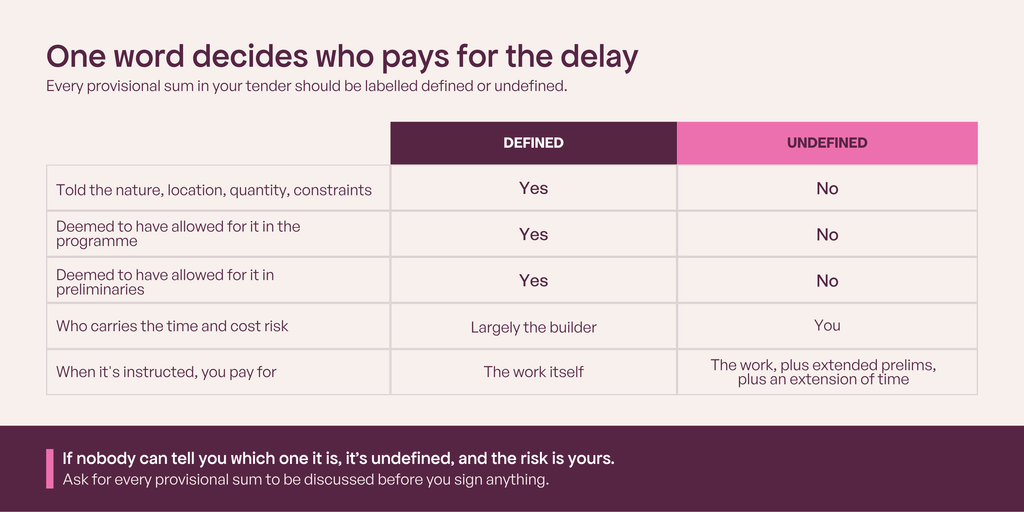
Where a provisional sum is defined, the builder has been told the nature, location, quantity and constraints, and is deemed to have allowed for the work in both their programme and their preliminaries, so the time and cost risk sits largely with them and the instruction covers the work itself. Where it’s undefined, none of that applies, the risk sits with you, and instructing it can bring extended preliminaries and an extension of time along with the work.
So when an undefined provisional sum gets instructed, the employer assumes the price and planning risk and has to grant the allowances that follow. In homeowner terms: you pay for the work, you pay for the extra weeks of site management and scaffold and permits that the work drags behind it, and the completion date moves.
This is exactly why preliminaries and provisional sums can’t be read separately. As covered in the prelims article, roughly half of a typical prelims line is time-related, so anything that extends the programme quietly re-runs that meter. An undefined provisional sum is one of the most common things that does.
The fix is unglamorous and completely within your control. Every provisional sum in your tender documents should be labelled defined or undefined, and for every one marked defined, the supporting information should actually be there.
Why a low provisional sum is never your builder’s problem
This one surprises people, and it’s the reason a low allowance is worth more scrutiny than a high one.
Guidance from RICS is that a contractor bears no risk for whether a provisional sum was adequate. They aren’t responsible for estimating whether the number reflects what the work will actually cost, and that holds whether the sum is defined or undefined. The allowance is replaced by the real cost when the work happens, and the difference lands on you.When a builder writes £2,000 for sanitaryware across two bathrooms, they haven’t taken on a £2,000 obligation.
They’ve written down a number that will be swapped for whatever the sanitaryware costs. If you’ve been sending them photographs of Drummonds baths, the gap arrives on your final invoice, and nothing about that is a breach of anything.
A builder pricing measured work carries the risk of getting it wrong. A builder writing a provisional sum doesn’t. It’s the same document, but the risk sits in completely different places depending on which side of the line an item falls, which is why the volume of provisional sums in a quote matters as much as the total at the bottom.
A provisional sum is not a licence to spend the allowance, and it isn’t a promise that the allowance will be enough. It’s a marker saying a decision hasn’t been made yet.
How much of a quote is normally provisional?
More than most homeowners realise, and quite often more than the builder has drawn attention to.
We priced a full refurbishment of a listed fourth-floor mansion flat in SW5 at £209,341 excluding VAT. When we went back through it and isolated every allowance, the total came to £48,428, which is 23% of the tender. It broke down like this:
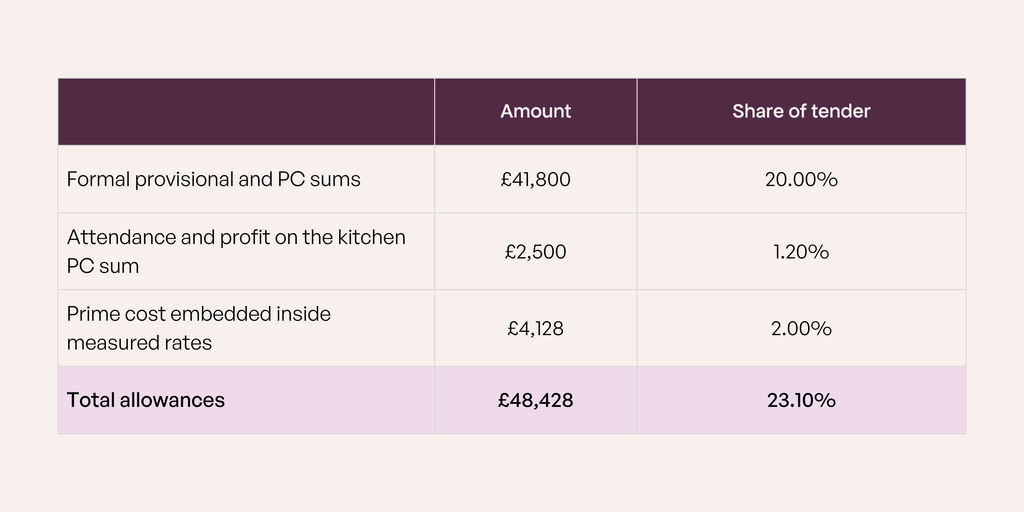
The first line is the one a homeowner would spot, because it’s labelled. The other two are the interesting ones.
Attendance and profit on a PC sum is the builder’s charge for receiving, protecting and coordinating an item you’re supplying, and it moves when the item’s value moves. And prime cost embedded inside measured rates is the sneakiest of the three, because it doesn’t appear as an allowance anywhere. A rate for tiling that quietly assumes a £40 per square metre tile is carrying a prime cost inside it, and if you choose a £95 tile, that rate was never going to hold.
So the honest reading of that tender wasn’t “£209,341 with a few allowances”. It was “£161,000 of firm pricing and £48,000 of decisions still to make”.
As a working rule, if the labelled provisional and PC sums come to more than about 15% of the total, you don’t have a price, you have a range. And before you accept the 15%, add up the unlabelled ones too.
What a properly written provisional sum looks like
Ours are governed by four rules, and they’re the same four we’d suggest to any homeowner regardless of who’s managing the job.
There are only really four explanations for it, and three of them cost you money:
- It’s classified. Every provisional sum is marked defined or undefined, and every PC sum is identified as a PC sum rather than being left to look like fixed pricing.
- It’s spent only on written instruction. No provisional sum is drawn down because the builder thought it was a good idea. It’s spent when the client says so, in writing.
- It’s reconciled against actual cost, with evidence. Invoices, not assertions. The allowance is a placeholder and the invoice is the truth.
- Any unspent balance is credited back to you. This is the one homeowners most often don’t realise they’re entitled to. If the drainage allowance was £4,000 and the repair cost £2,300, you get £1,700 back. It isn’t the builder’s to keep.
That fourth point is worth repeating, because if a provisional sum can only ever go up, it isn’t a provisional sum, it’s a minimum.
The allowances that most commonly need this treatment on a London refurbishment are asbestos removal, ground obstructions and contamination, drainage repair pending a CCTV survey, local authority permits, period feature restoration where matching is required, and the client-selected supply items covered by PC sums.
Five questions to ask about every provisional sum
- Is this defined or undefined? If the answer is a blank look, it’s undefined, and you’re carrying the time risk.
- What specification or quantity has been assumed? A number without an assumption behind it is a guess dressed up as a budget.
- When does this need to be fixed? Every provisional sum has a date beyond which it starts costing you money to still be undecided.
- What happens to the unspent balance? The answer should be that it comes back to you.
- Are there any allowances buried in the measured rates? Ask specifically about tiles, flooring, sanitaryware, ironmongery and worktops.
If the answers are good, a quote with provisional sums in it is more honest than one without. A builder who writes a considered provisional sum for drainage they haven’t surveyed is telling you the truth. A builder who writes a firm price for the same drainage is either taking a gamble or planning a variation.
The real fix: fewer of them
Everything above is damage limitation. The actual solution is to have fewer provisional sums in the tender in the first place.
Provisional sums exist because a decision hasn’t been made, and most of those decisions could have been made earlier. The tiles could have been chosen before tender. The CCTV drainage survey could have been done before tender. The asbestos survey almost always could have been done before tender. Each one that gets resolved before the documents go out converts a range into a price.
That’s the whole argument for finishing the design before you go to market, and for a written Schedule of Works that fixes every allowance at the same figure across every builder. When all three contractors are pricing an identical £6,000 sanitaryware allowance, the differences between their quotes are real differences.
Tags
Renovate the savvy way
- Simplified process with support throughout
- Pay the right price with proven Pagers
- Transparent pricing & timelines
SHARE THIS ARTICLE