Back to blog
What’s the difference between a quote and an estimate?
One gives you a guide price, the other sets it in stone.

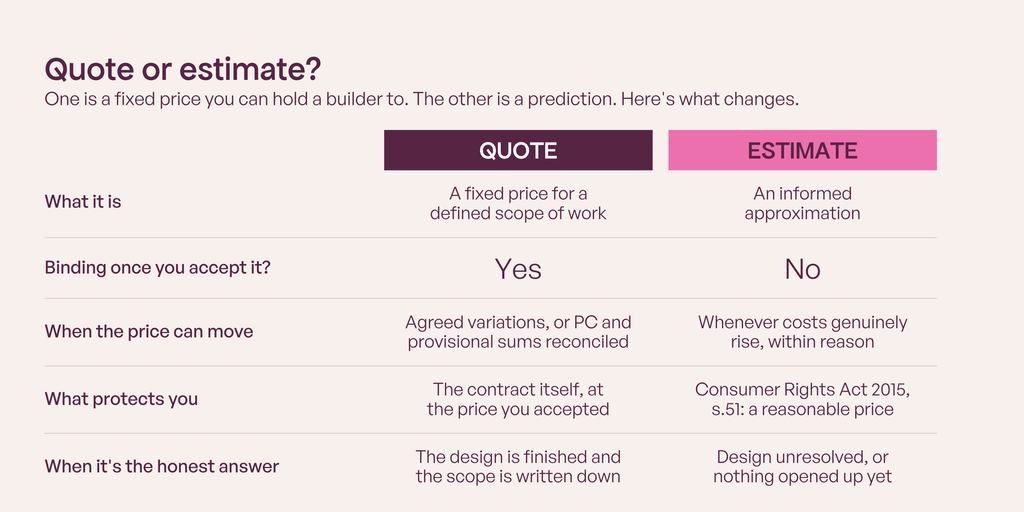
A quote is a fixed price for a defined scope of work, and once you accept it, whether in writing, by text, or by letting the builder start, it forms a binding contract at that price. An estimate is an informed approximation and it isn’t binding, though under section 51 of the Consumer Rights Act 2015 you only ever have to pay a reasonable price where no price was fixed. The practical difference is that a builder can’t lift a quote because the job proved harder than they thought, but they can revise an estimate.
We’ve read hundreds of builders’ quotes, and the pattern is consistent: documents headed “Quotation” that behave like estimates, documents headed “Estimate” that hold to the penny, and homeowners who thought the heading was the protection finding out in month four that it wasn’t.
So this piece covers the legal distinction properly, and then the more useful question underneath it, which is what actually makes a price hold.
This is the fifth in a series on reading a builder’s quote. The others cover what a quote should contain, preliminaries, provisional sums and prime cost sums.
The legal position, briefly
A quote is an offer. When you accept it, a contract forms at that price, and acceptance doesn’t have to be a signature. Saying yes by email, replying to a text, or simply letting the builder start work will generally do it. From that point the builder is committed, and the fact that the job turned out to be harder, longer or more expensive than they expected is their problem rather than yours.
An estimate is a prediction, and it commits the builder to nothing. That doesn’t leave you without protection. Where no price was ever fixed, section 51 of the Consumer Rights Act 2015 entitles you to pay a reasonable price rather than whatever arrives on the invoice, and what counts as reasonable is judged on the facts: what similar work costs locally, whether you were told costs were rising while the job ran, and whether the builder kept records.
Trade guidance treats a 10 to 15% overrun as the threshold at which a builder should stop and get your agreement before continuing. That’s good practice rather than a statutory ceiling, so don’t read it as a cap, but it’s a reasonable thing to ask a builder to commit to in writing at the outset.
Deliberately lowballing an estimate to win work and then charging substantially more can amount to an unfair commercial practice under the Consumer Protection from Unfair Trading Regulations 2008. That’s a different and more serious matter than an honest estimate that drifted.
And a contract term letting a builder raise the price without consulting you may itself be unenforceable as an unfair term. A clause in a document you signed isn’t automatically binding just because it’s there.
The heading doesn’t decide which one you’ve got
Plenty of documents are headed “Quotation” and then, somewhere below, carry wording that quietly makes the whole thing provisional. “Subject to survey.” “Subject to final specification.” “Prices held for materials at today’s rates.” “Scope as discussed on site.” Each of those, in its own way, hands the builder room to move, and a document with enough of them is an estimate wearing a quote’s clothes.
There’s a simple test, and it doesn’t require any legal knowledge at all. Could a builder who had never visited your house price this document and arrive at roughly the same number? If yes, it’s a quote, because the work has been defined well enough to be fixed. If no, then whatever the heading says, the number is provisional, because too much is still being carried in somebody’s head.
Even a real quote isn’t as fixed as you think
There are three entirely legitimate ways a fixed-price quote goes up, and none of them is a breach of anything.
Variations. You change your mind, or the design changes, or something is discovered that genuinely wasn’t in the scope. The extra is chargeable, and a variation you agreed to is exactly as binding as the quote it altered.
Provisional and PC sum reconciliation. These are allowances, not prices, and they’re replaced by actual cost when the work happens or the item is chosen. We covered why that risk sits with you rather than the builder in the pieces on provisional sums and prime cost sums. On one tender we analysed, 23% of the total was allowances rather than fixed pricing.
Scope gaps. Work that was never in the quote to begin with, because nobody wrote it down.
What a builder can’t do is raise a fixed quote because materials went up, because the job took longer than they allowed, or because they underpriced it. That’s the risk they took when they gave you a fixed price, and it stays theirs.
Why “we’ve got three quotes” doesn’t mean you can compare them
We ran a tender on a refurbishment in south west London where 3 vetted Pagers pricing the same property. All three documents were headed “Quotation”. All three were fixed prices. They came back at £169,771, £181,180 and £199,120 before VAT.
The £29,349 gap wasn’t a difference in price. It was a difference in what each builder thought they’d been asked to do. One had priced repointing, scaffolding and external decoration at between £9,700 and £17,400 that the other two hadn’t mentioned. The steelwork varied by 56% between two of them. One allowed £1,250 for a boiler, supply and fit.
Every one of those was a fixed-price quote, legally binding on acceptance. And the cheapest one was binding on a job that didn’t include the work the house actually needed.
A fixed price is only ever as fixed as the scope it was priced against. Bind a builder to the wrong scope and you’ve bound them to nothing that helps you.
That’s why we write a single Schedule of Works and have every builder price the same document. It doesn’t make their quotes more binding. It makes them binding on the same thing, which is the part that actually protects you.
What actually makes a price hold
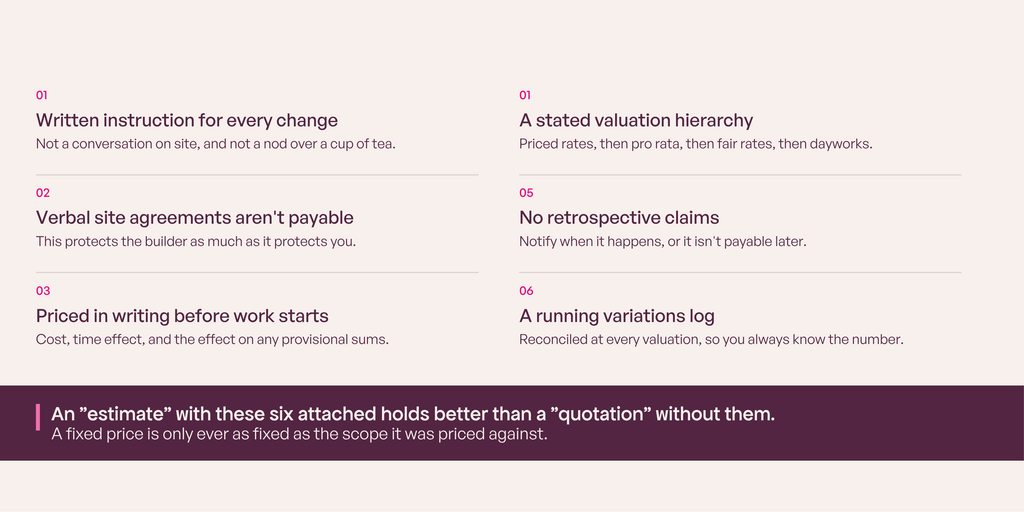
Six clauses do more work than the word at the top of the page, and they’re the six we mark as non-negotiable in our own scope of works documents.
- No change without the client’s written instruction. Not a conversation, not a nod on site.
- Verbal site agreements are not payable. This protects both of you, and it’s the one builders most often thank us for.
- A written quotation is required before varied work starts, covering the cost, the time effect, and the effect on any provisional sums. Price the change before it happens, not after.
- A stated valuation hierarchy: priced rates first, then pro rata, then fair rates, then dayworks. So there’s an agreed method for pricing a change rather than an argument.
- No retrospective claims. Notify in writing when the event arises, or it isn’t payable. This kills the month-nine invoice for something that happened in month two.
- A running variations log, reconciled at every valuation. So you always know the current number rather than discovering it at the end.
A document headed “Estimate” with those six clauses attached will hold better than a document headed “Quotation” without them. That’s the whole argument of this article in one sentence.
Four things to do before you accept anything
- Run the stranger test. Could someone who’s never seen your house price this document?
- Get the word in writing. Ask the builder to confirm in writing whether it’s a fixed quote or an estimate. If they hesitate, you have your answer.
- Ask for the six clauses. Written instructions, no verbal agreements, priced before it starts, a valuation hierarchy, no retrospective claims, a running log.
- Total the allowances. Add up the provisional and PC sums, including any hidden in measured rates, and take that off the “fixed” part of the price.
The short version
A quote binds, an estimate doesn’t, and if you’re ever in a dispute about a runaway estimate, section 51 is the thing to know about.
But in five years of reading these documents, we’ve seen far more money lost to vague scopes and missing variations clauses than to the difference between two words. The homeowners who get hurt are rarely the ones who accepted an estimate. They’re the ones who accepted a fixed-price quote for a job nobody had properly written down.
We write the Schedule of Works, run the tender with three or four vetted builders, and issue every tender with the six variations clauses attached and unsoftened. Get in touch.
Tags
Renovate the savvy way
- Simplified process with support throughout
- Pay the right price for proven Pagers
- Transparent pricing & timelines
SHARE THIS ARTICLE