Back to blog
Why are builders’ quotes so different for the same job?
One gives you a guide price, the other sets it in stone.
Builders’ quotes differ because builders are almost never pricing the same job. Some of the gap is real: different rates, different overheads, different amounts of management. Most of it is scope. What each builder assumed, included, excluded or missed, none of which shows in the number at the bottom of the page.
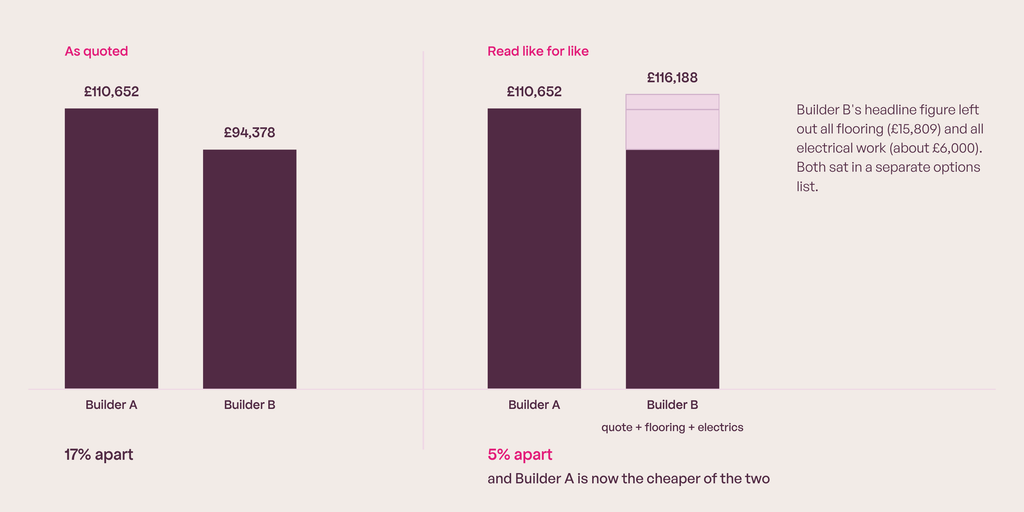
Looking at five of our London renovations we’ve run in 2026, the gap between the lowest and highest quote averaged 12%. On the widest, a flat refurbishment in W11, the two quotes looked 17% apart. Once we added back the electrics and the flooring that one builder had left outside his headline figure, the real gap was 5%, and the builder who looked expensive was the cheaper one.
Most quote differences aren’t price differences. They’re scope differences wearing a price.
How different are builders’ quotes, really?
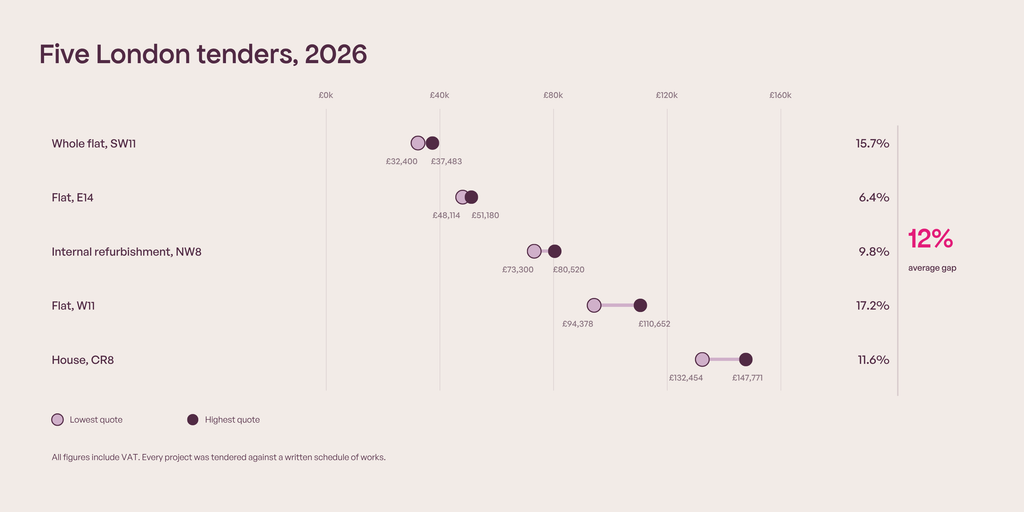
Every homeowner above was working from a written schedule of works, which is why the spread stays in a sane range. Without one, it’s a different order of magnitude. We’ve seen the same renovation quoted at £6,000 and at £22,000, because at that point you aren’t comparing builders, you’re comparing guesses.
The headline gap is also often not the real gap. This W11 renovation below, for example, saw the “more expensive” builder actually being the cheaper one due to builder B leaving out electrical and flooring works.
Six reasons builders’ quotes differ
1. They’re pricing different scopes
This is the biggest cause by a distance, and it’s rarely deliberate. Two builders walk the same rooms, hear the same brief, and leave with slightly different projects in their heads.
On that W11 job, both builders priced the roof terrace as a full rebuild, tearing up the paving and starting again. One at £2,610, the other at £8,279. Neither was wrong. Neither had been told the job was to lift and re-fix the existing tiles.
Watch for doors one builder supplies and the other only fits, boilers one services and the other ignores, top coat paint you’re expected to buy, and extractor fans that appear in one quote and nowhere else.
2. What sits outside the price
A quote is defined as much by what it leaves out as by what it puts in. Three patterns come up constantly.
Options lists. Work you definitely need, priced separately so it doesn’t land in the headline figure. The W11 quote is the clearest example we have.
Per point and per square metre pricing. On an SW11 flat, one builder priced electrics per point (£2,465) and flooring at £39 per square metre over an estimated 49m². Both figures move once someone counts and measures. The other two priced the same work as fixed sums.
By others. Worktops, carpets, stone, glazing. Normal enough, but if one builder says it and the other doesn’t, the totals aren’t comparable.
A quote is only comparable when every builder has priced the same scope, with the same exclusions, on the same basis.
3. Genuinely different rates for the same work
Even when two builders price an identical schedule of works line by line, they don’t price it the same way.
On a CR8 house renovation this summer we issued one schedule and both builders priced every line. The totals came back £15,317 apart, about 12%. What happened underneath is more interesting.
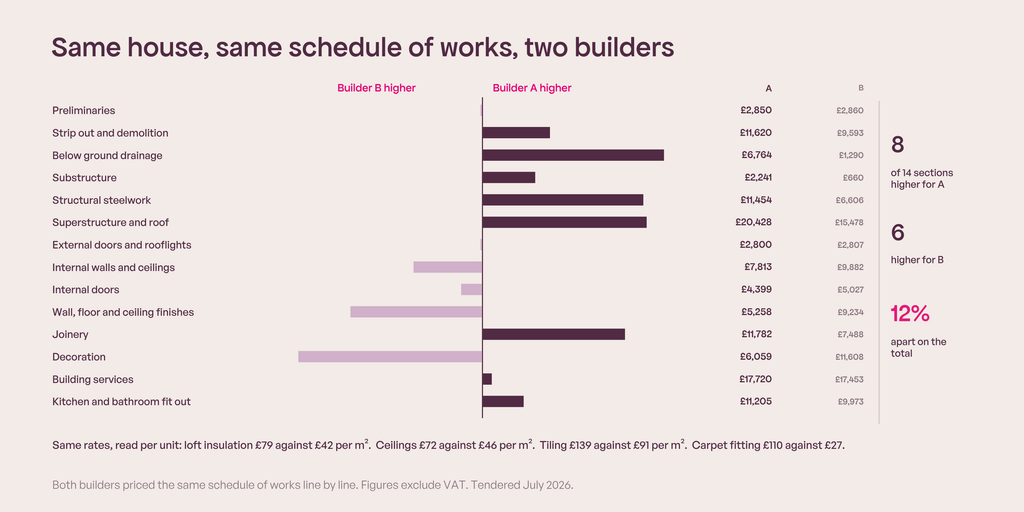
Neither builder was cheaper across the board. The idea of a cheap builder and an expensive builder mostly dissolves once you read line by line, which is exactly why the bottom line number is such a poor way to choose.
4. Different amounts of management
A sole trader with two lads isn’t selling the same thing as a company with a site manager, a foreman and an office. The second costs more because it is more.
Across those projects that showed up as on site daily, versus twice a week, versus weekly. A project manager sending a written update, versus the owner posting photos to a WhatsApp group. And preliminaries priced as one visible line covering site set up, scaffolding, management and insurance, versus the same costs spread invisibly through every rate below.
Compare a sole trader’s total against a managed contractor’s total and take the lower one, and you haven’t saved money. You’ve bought a different service.
5. VAT and company structure
This creates an instant 20% difference and has nothing to do with the work.
A builder turning over less than the VAT registration threshold of £90,000 doesn’t have to register, and doesn’t charge VAT. A VAT registered company does. On a £40,000 job that’s £8,000 between two builders doing identical work to an identical standard.
There’s a second point almost nobody knows. Some residential work qualifies for a reduced 5% VAT rate instead of 20%, most commonly where a property has been empty for two years or more, or where you’re changing the number of dwellings. The rules sit in HMRC’s VAT Notice 708. If one builder has applied it and another hasn’t, the quotes are 15 points apart before anyone has priced a brick.
Always check whether a quote includes VAT and at what rate. “£45,000” and “£45,000 plus VAT” are £9,000 apart.
6. How much the builder wants your job
The least discussed reason, and a real one. Builders price appetite as well as work. One who’s booked until spring, or thinks your project sounds difficult, will often price high rather than decline. One with a gap in the diary next month sharpens his pencil.
You can’t see this in a quote. You can see whether it’s been priced carefully, itemised and specific, or thrown together with round numbers.
How to get quotes you can compare
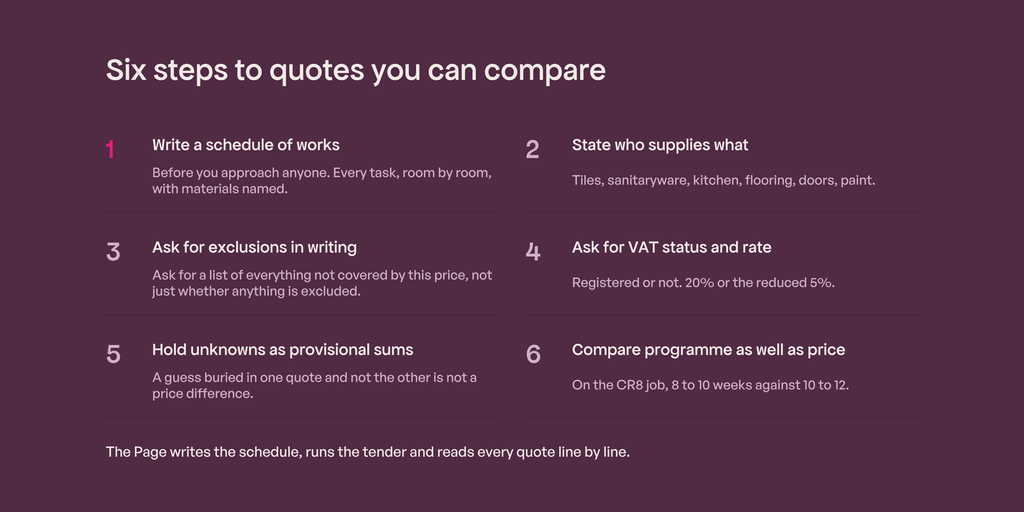
The fix isn’t more quotes. It’s giving every builder the same brief.
Should you take the cheapest quote?
Sometimes, yes. The cheapest quote is often the best one, when it’s complete, itemised and from a builder with the right references.
The problem is that a low quote and an incomplete quote look identical on paper. Work that’s been left out doesn’t disappear. It comes back as a variation halfway through, at a price you can no longer negotiate. One homeowner came to us after a £6,000 invoice landed for work she’d never agreed to.
The question isn’t which is cheapest. It’s which builder has understood your project.
How The Page makes quotes comparable
We write your Schedule of Works, put the identical scope to matched builders from our vetted network, then read every quote line by line so you don’t have to. You get one document comparing price, scope differences, management, procurement, payment terms, warranty and programme, side by side.
Common questions
How much should builders’ quotes vary for the same job? With a proper schedule of works, roughly 5% to 15% between lowest and highest. Across five London tenders in 2026, our average was 12%. Without a written scope the spread can be 100% or more, and that’s telling you about the brief, not the builders.
Why is one builder’s quote half the price of another’s? Almost always because they’re pricing different work. Check for excluded electrics, flooring, first fix materials, VAT, and anything sitting in a separate options list.
Do builders’ quotes include VAT? Not always. A builder turning over less than £90,000 a year isn’t VAT registered and won’t charge it. Always ask whether a figure is inclusive or exclusive, and whether the reduced 5% rate applies to your property.
How many builders should I ask to quote? Three suits most renovations. Fewer and you’ve no benchmark. More and good builders lose interest.
What’s the difference between a quote and an estimate? A quote is a fixed price for a defined scope. An estimate is an informed guess that can change. If the document doesn’t describe the work in detail, it’s an estimate whatever it’s called.
Should I tell builders what the other quotes are? No. Tell them the scope, not the numbers. Sharing figures invites builders to price to a target rather than to the work.
Tags
Renovate the savvy way
- Simplified process with support throughout
- Pay the right price for proven Pagers
- Transparent pricing & timelines
SHARE THIS ARTICLE