Back to blog
Why is the cheapest quote usually the most expensive in the end?
The cheapest quote often is missing out part of the project, make sure your builders are quoting on the whole job.

Because the cheapest quote is usually the least complete one, not the cheapest job. Work that was never priced doesn’t disappear. It comes back after you’ve signed, as a variation, priced by one builder with nobody to compete against.
That’s the whole mechanism. A low quote wins on paper because it realistically has less in it, prices unknowns as if they’re known, or comes from a builder who intends to make the margin back once you’re committed. The saving is real on the day you choose. It’s gone by week six.
The discount you get before you sign is competitive. Every price after that is not.
On a W11 flat renovation this year, the cheaper of two quotes was 17% below the other. It ended up the more expensive builder before a wall came down.
What the numbers actually did on that job
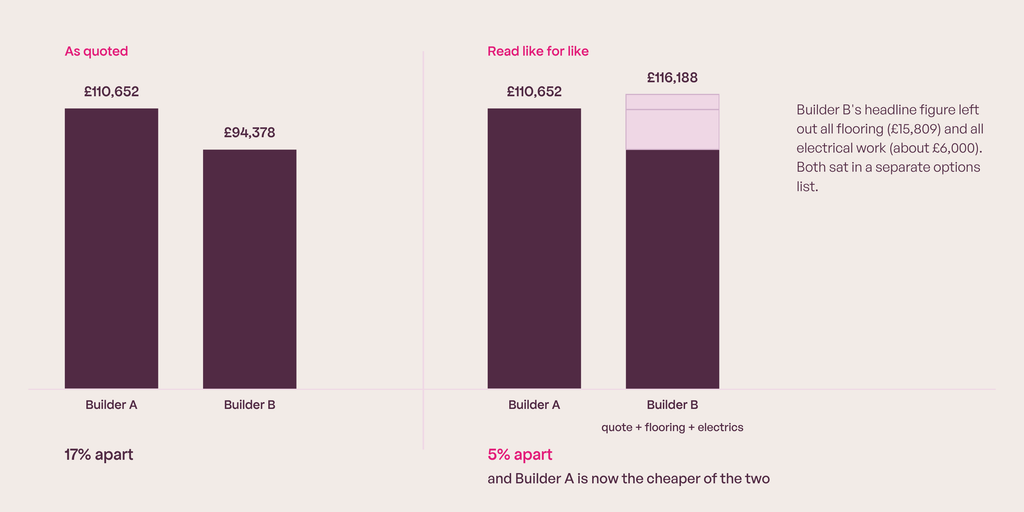
Builder B came in at £94,378. Builder A at £110,652. On the headline you save £16,274 by taking B.
B had left the electrics out, around £6,000, and the flooring, £15,809. Both were work the homeowner definitely needed. Add them back and B is £116,187 against A’s £110,652. The £16,274 saving becomes £5,535 spent, and the order of the two builders reverses.
Nothing dishonest happened. B priced what he’d been asked about and listed the rest as options at the back. The quote was accurate. It just wasn’t complete, and complete is what you’re comparing.
How often does this actually happen?
Often enough that it’s the single most common way a London renovation goes wrong, and it goes wrong at the quote stage rather than on site.
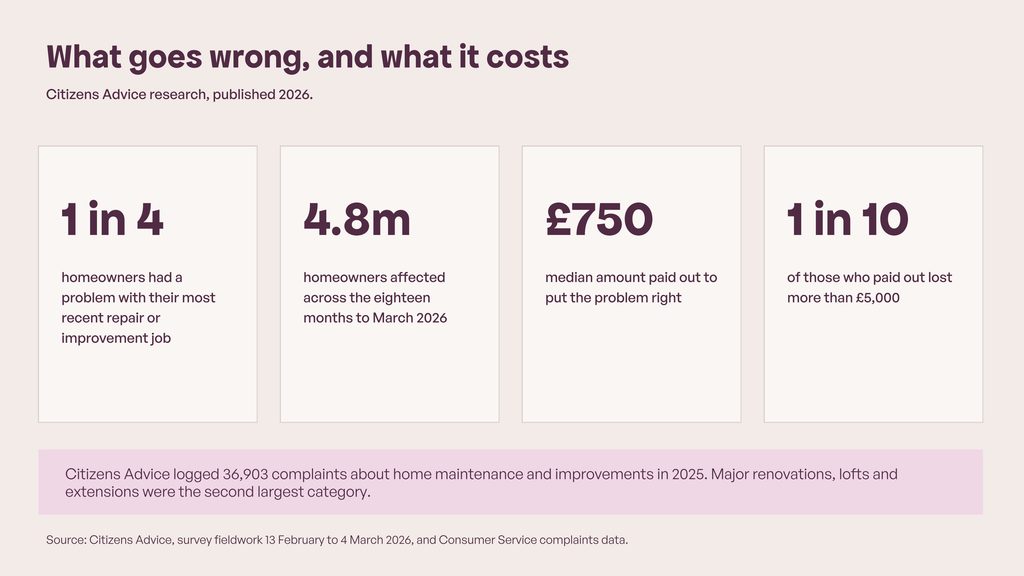
Citizens Advice research published in 2026 found that one in four homeowners had a problem with their most recent repair or improvement job, about 4.8 million people over 18 months. Of those who paid extra to put things right, the median loss was £750, and one in ten paid more than £5,000. Citizens Advice took 36,903 complaints about home maintenance and improvements in 2025 alone, with major renovations, loft conversions and extensions the second largest category.
Our own numbers point at the same stage of the process. Across five London tenders we ran in 2026, all with a written schedule of works behind them, the gap between lowest and highest quote averaged 12%. Without a written scope we’ve seen the same renovation quoted at £6,000 and at £22,000. At that point you aren’t choosing a cheaper builder. You’re choosing whichever builder guessed lowest.
Six ways a cheap quote gets expensive
1. Missing work comes back as a variation
The most common one, and the most expensive, because of when it lands rather than what it costs.
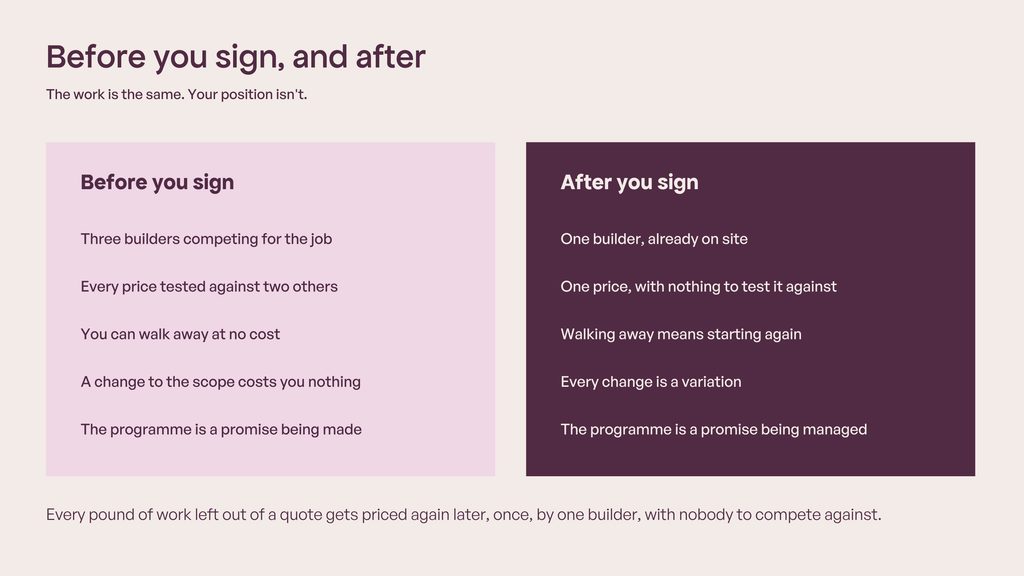
While three builders are competing for your job, every price is a competitive price. The moment you sign, that stops. The builder is on site, your kitchen is out, and the work still has to happen. There’s no second quote and no realistic option to change builder. Whatever the number is, you pay it.
One homeowner came to us after a £6,000 invoice arrived for work she’d never agreed to. On a CR8 house renovation this summer, lining two quotes up section by section found £4,175 of work one builder had priced and the other simply hadn’t. Caught before signing, that’s a conversation. Caught after, it’s an invoice.
The things that turn up as variations are boringly predictable: electrics, flooring, top coat paint, internal doors, extractor fans, boiler works, skips and waste, scaffolding, making good, temporary works, structural engineer’s design and building control fees. There’s a fuller list in what should be included in a builder’s quote.
2. Rates that move once somebody counts
Some lines aren’t prices at all. They’re prices multiplied by a quantity nobody has checked.
On an SW11 flat, one builder priced the electrics per point, £2,465, and the flooring at £39 per square metre over an estimated 49m². The other builders gave fixed sums for the same work. The per point and per square metre figures were the lowest on the page and the only ones that could rise without anyone doing anything wrong.
Rate based pricing isn’t a trick. It’s how a builder prices work he can’t yet count. But a quote built mostly on rates and estimated quantities is a forecast, not a fixed price, and it will nearly always be the cheapest one in the pile.
3. Provisional sums set too low
A provisional sum is a placeholder for work that can’t be defined yet, usually because it’s hidden behind plaster or under a floor. It gets replaced by a real price later.
Two builders can hold the same unknown at very different figures. The one who allows £2,000 for underpinning you might need looks cheaper than the one who allows £8,000, and neither has told you a lie. Only one of them has told you what it’s likely to cost.
The same applies to a prime cost sum for tiles or sanitaryware. A low allowance flatters the total and you pay the difference at the tile shop.
When you compare two quotes, compare the allowances as carefully as the fixed prices. A cheap quote is often just a quote with cheaper assumptions.
4. Materials swapped for cheaper ones
If the specification is vague, the price can only be tested against the specification you gave. Say tiles and you’ll get whatever tiles balance the number.
We’re currently supporting a homeowner on a project where a specified material was replaced with a cheaper one without being raised. Our comparison concluded the substitution was an undisclosed replacement, which brings it under the Consumer Rights Act 2015 rather than being a matter of taste. Getting to that position took a written specification and a paper trail. Without both, it’s one person’s word against another’s.
Specification is where a quote becomes checkable. Name the product, the finish, the thickness and the range, and the price stops being negotiable in the wrong direction.
5. Thinner management, and a longer programme
A sole trader with two lads isn’t selling the same thing as a company with a site manager, a foreman and an office. The second costs more because it is more, and some of what you’re buying is time.
On that CR8 house the two builders quoted 8 to 10 weeks and 10 to 12 weeks for the same schedule of works. If you’re renting while the work happens, two extra weeks is a real cost that appears in neither quote. Nobody itemises it, and you pay it in full.
Site presence follows the same pattern. Daily, twice a week, or a call on Friday. The cheaper quote is often the one with the least management in it, and management is what stops a three day problem becoming a three week one.
6. A builder who priced too low to finish
The uncomfortable one. A builder who has underpriced your job still has wages to pay on Friday, and the money has to come from somewhere. Usually it comes from front loading the payments, then from your job funding somebody else’s.
That’s the sequence behind most disappeared builders. Large deposit, stage payments running ahead of the work completed, then a slowdown and then nobody on site. We’ve written about the payment structure that prevents it. Monthly valuations against work actually completed, with 5% retention held to practical completion and 2.5% to the end of the defects period, is the standard to hold out for.
A price so low that the builder can’t make money on it isn’t a bargain. It’s a risk you’ve agreed to carry.
Why the same work costs more after you’ve signed
This is the part homeowners rarely see coming, because it isn’t about the builder’s character. It’s about position.
During a tender, three builders are pricing against each other and against the risk of losing the job. That competitive tension is doing real work on your behalf, and it’s the only leverage you get in the whole process.
Once the contract is signed and the site is stripped, the tension is gone. A variation is priced by the only builder available, for work that has to be done, at a moment when your alternative is an empty house and a new tender. Most builders price variations fairly. They don’t have to.
So the value of a complete quote isn’t tidiness. It’s that it moves as many decisions as possible to the side of the line where you still have options.
Every pound of work left out of a quote gets priced again later, once, by one builder, with nobody to compete against.
Two prices for the same line
It’s worth seeing what a like for like comparison looks like when both builders have priced the same schedule, because it kills the idea of a cheap builder and an expensive builder.
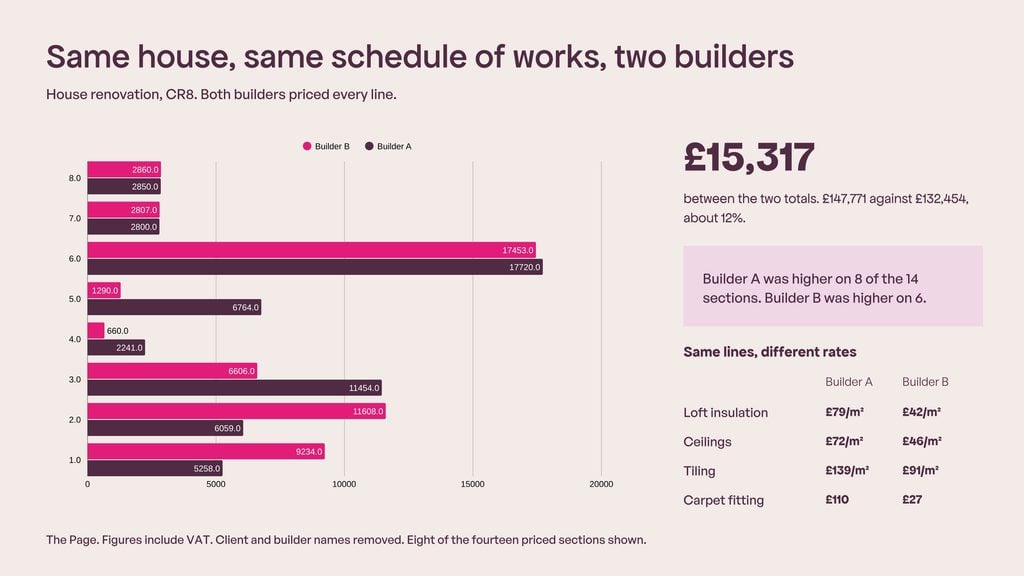
Both builders priced every line of one schedule of works. The totals came back £15,317 apart, £147,771 against £132,454. Underneath, Builder A was higher on eight sections and Builder B on six. They were within £10 of each other on preliminaries and within £7 on external doors and rooflights, then thousands apart on drainage, steel and decoration.
Neither was cheaper across the board. The builder with the lower total was more than twice the other on decoration. If you’d only read the totals you’d have known none of that, and you’d have had nothing specific to negotiate on.
Line by line reading is also where negotiation actually lives. You can ask each builder about his own outliers, which is a fair question a good builder will answer, rather than asking anyone to beat a number.
When the cheapest quote is the right one
Often. We’re not arguing that low means bad.
The cheapest quote is the right choice when it’s itemised, when its exclusions are written down, when the unknowns are held as provisional sums rather than guessed at, when the references check out, and when it covers the same scope as the others. Plenty of builders are simply cheaper: lower overheads, a quieter month, a job round the corner from their last one, or not registered for VAT.
That last one is worth saying plainly, because it produces an instant 20% difference that has nothing to do with quality. A builder turning over less than the VAT registration threshold of £90,000 doesn’t have to register and won’t charge it. Some residential work also qualifies for a reduced 5% rate rather than 20%, most commonly where a property has been empty for two years or more, or where you’re changing the number of dwellings. The rules are in HMRC’s VAT Notice 708.
The problem isn’t that cheap quotes are bad. It’s that a genuinely cheap quote and an incomplete quote look identical on paper, and only one of them stays cheap.
Common questions
Is the cheapest builder’s quote always a bad sign? No. It’s a signal to check, not to reject. A cheap quote is fine when it’s itemised, its exclusions are written down, its unknowns sit in provisional sums and it covers the same scope as the others. It’s a problem when it’s cheap because work is missing.
Why do builders leave work out of a quote? Usually because nobody told them it was in. Two builders walk the same rooms, hear the same brief and leave with slightly different projects in their heads. Sometimes it’s deliberate, to keep the headline figure low. Both produce the same outcome for you.
How much more do variations cost than the same work priced in a tender? There’s no published figure we’d trust, because it depends entirely on the builder and the moment. The structural point is what matters: a variation is priced by one builder, for work that has to happen, at a point when you have no alternative. Even a fair price is a price you didn’t test.
What’s the difference between a cheap quote and an incomplete quote? A cheap quote prices all the work at lower rates. An incomplete quote prices less work. On paper they look the same. Reading the exclusions is what separates them.
Should I tell the cheapest builder what the other quotes said? No. Share the scope, never the numbers. A builder shown a rival’s figure prices to that target rather than to the work, and the difference tends to come back later as a variation.
Can I ask a builder to explain why he’s so much cheaper? Yes, and it’s one of the more useful conversations you’ll have. Name the sections where he’s below the others and ask him to talk you through his allowance. A builder who has priced carefully will have an answer. One who guessed won’t.
How many quotes should I get? Three suits most renovations. Two gives you a comparison but no benchmark, so if both builders misread the scope in the same direction, nothing tells you. More than four and good builders lose interest, because tendering costs them a day of somebody’s time.
The bottom line
The cheapest quote gets expensive when it’s cheap for the wrong reason. Missing scope, moving rates, thin allowances, vague specification, no management, or a builder who can’t afford the job he’s just won.
Tags
Renovate the savvy way
- Simplified process with support throughout
- Pay the right price for proven Pagers
- Transparent pricing & timelines
SHARE THIS ARTICLE