Back to blog
Is it a bad sign if a quote has no breakdown?
Detailed quotes mean the builder has understood your project, the more detail the better.

Usually, yes. A quote with no breakdown isn’t proof that a builder is hiding something, but it does mean you can’t check what you’re buying, can’t compare it fairly against another quote, and have no agreed basis for pricing changes later. Amongst projects we’ve run across London in 2026, the cheapest headline figure was frequently not the cheapest job, and the only way to see that was in the breakdown.
A single figure on a page tells you one thing: the total. It doesn’t tell you what’s in it, what’s been left out, or how that number was reached. So the honest answer is that a quote with no breakdown is a bad starting point. How the builder responds when you ask for detail tells you far more than the missing breakdown itself.
What counts as a breakdown?
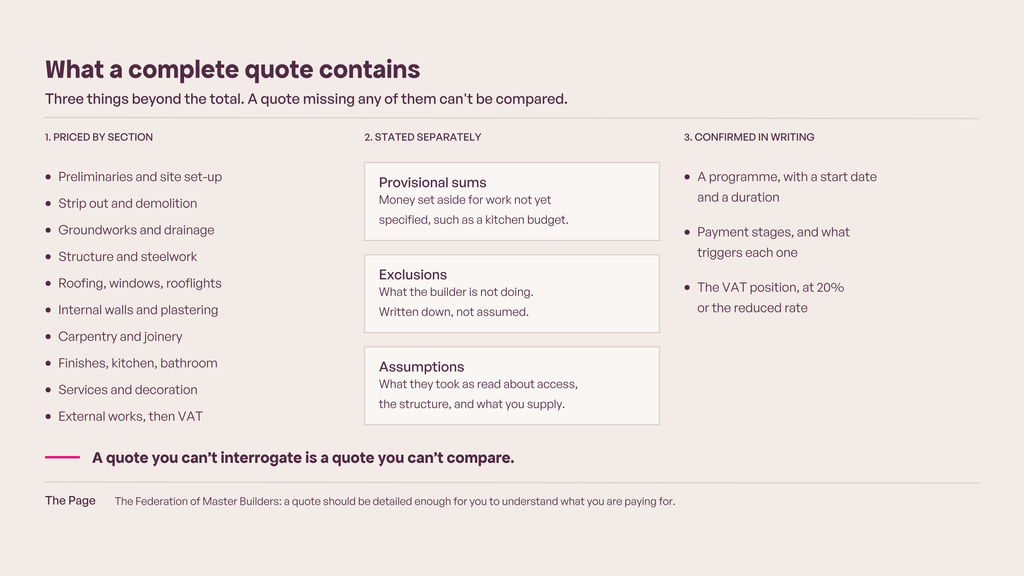
A breakdown is the quote showing its working. At a minimum, the price split by trade or work section, so you can see what each part of the job costs:
- Preliminaries, site set-up, scaffolding, skips and welfare
- Strip out and demolition
- Substructure, drainage and groundworks
- Structural steelwork
- Superstructure and external walling
- Roofing
- Windows, rooflights and external doors
- Internal walls and ceilings
- Carpentry and joinery
- Plastering
- Wall, floor and ceiling finishes
- Kitchen and bathroom installation
- Electrical, plumbing and mechanical
- Decoration
- External works
- VAT
Alongside those numbers, a proper quote sets out its provisional sums (allowances for work not yet fully specified, such as a kitchen supply budget), its exclusions (what the builder is not doing), and its assumptions (what they’ve taken as read about access, existing structure, or what you’re supplying).
The Federation of Master Builders puts the standard simply: a quote should be “detailed enough for you to understand what you are paying for”, covering labour, materials, VAT, fixtures, exclusions, waste removal, specialist trades, timescales and payment stages. If you want to go further on this, we’ve written a longer guide on how to read a builder’s quote.
What we find when we open the breakdown
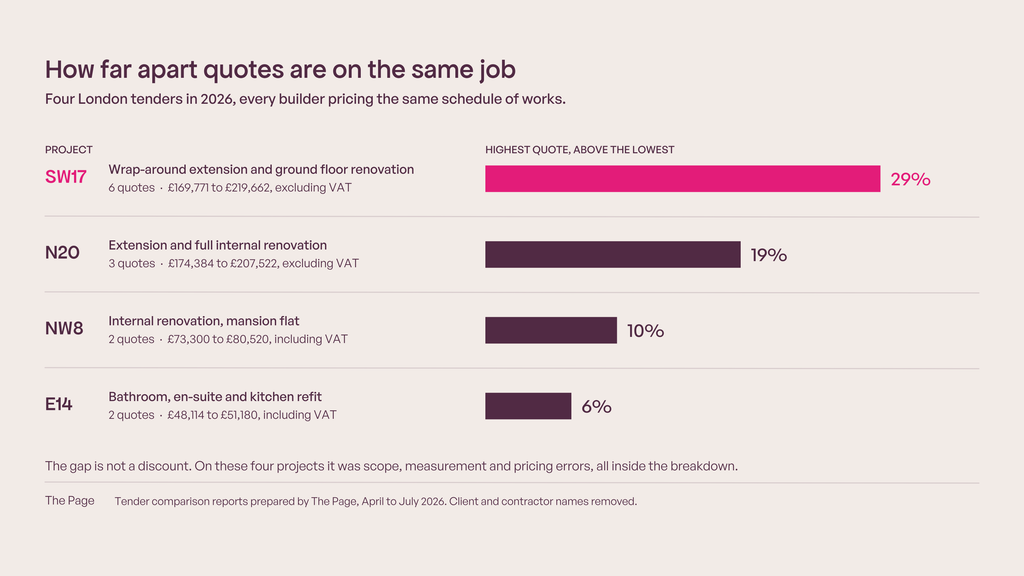
The Page has supported more than 1,300 London renovations, and every project that goes through our Scoping and Builder Selection service is priced by each Pager against the same written Schedule of Works. That means we see the same job costed several ways, line by line. Four examples from 2026 show what the detail exposes, and our full guide to how the process runs is here: everything you need to know about the tender process.
The cheapest quote came third
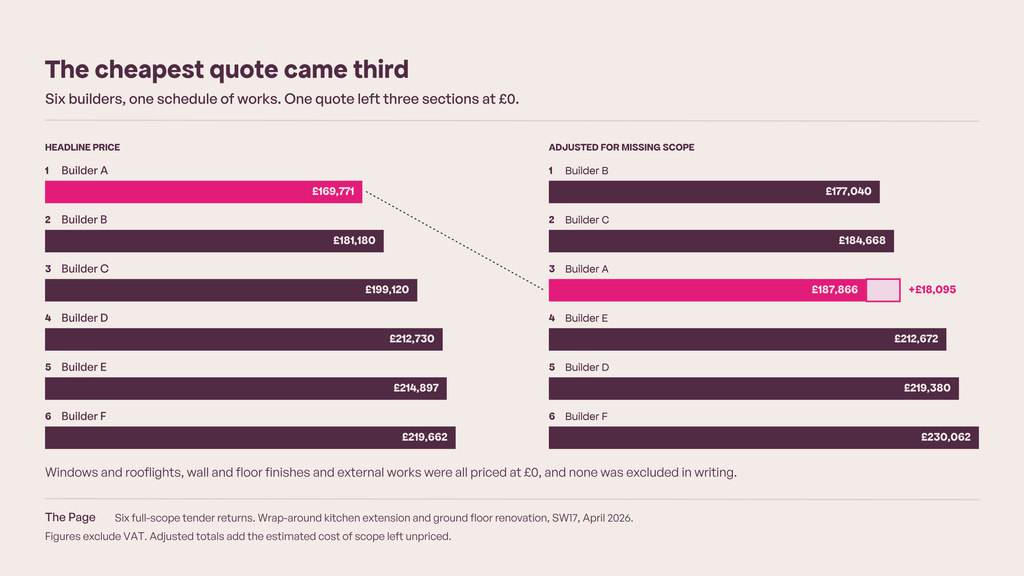
On a wrap-around kitchen extension and ground-floor renovation in SW17, seven contractors responded. One returned the lowest headline price by a clear margin, around £170,000 excluding VAT, roughly £11,000 below the next builder.
The breakdown showed three lines priced at zero: windows and rooflights, wall and floor finishes, and external works. None of it had been excluded in writing, it just wasn’t included. Once those items were costed back in at market rates, that quote’s adjusted total rose to around £188,000, moving it from first place to third.
Identical steelwork, priced at less than half
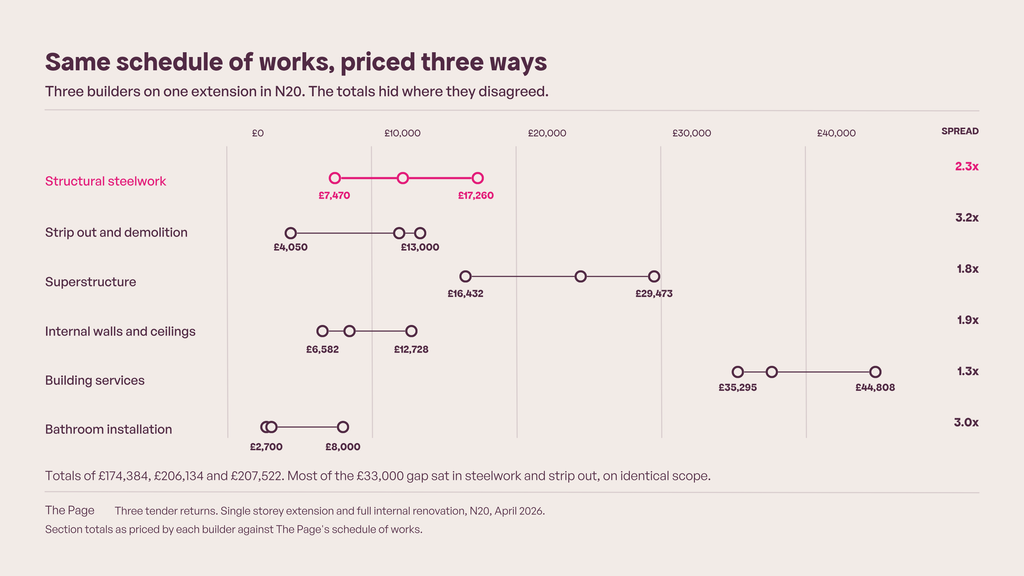
On an extension and full internal renovation in N20, three builders priced the same schedule. Their totals were £207,522, £206,134 and £174,384 excluding VAT.
The lowest looked like a £33,000 saving. The section comparison showed where it came from: structural steelwork priced at £7,470 against £17,260 from another builder, on an identical package of a 254×254 UC spanning six metres with specialist splice connections, an SHS post, baseplates and padstones, all set out on the structural engineer’s drawings. Strip-out and demolition came in at £4,050 against £11,550, for the same conservatory demolition, propping, load-bearing wall removal and two-storey strip-out.
The same comparison caught two further things. One builder had included a £3,800 provisional sum for a boiler the schedule explicitly excluded. Another had priced 27m² of external masonry where the drawings showed 7.53m², overstating their own total by roughly £5,000. Both were errors rather than tactics. Neither was visible from the totals.
Two prices, two different rooms
On a flat in E14, the two quotes were £51,180 and £48,114 including VAT.
The breakdown showed one builder had priced the bathroom within its existing layout, while the other had removed a storage-heater cupboard, built a new wall and reworked the pipework. Different finished rooms at almost the same price. The lower quote also carried kitchen electrics and the wet-room extractor and lighting in a separate optional list, outside the total.
When joinery has no number
On an internal renovation of a mansion flat in NW8, one builder itemised joinery separately at £24,700. The other priced the same joinery inside its room sections: alcove units within a £12,800 living room figure, built-ins within £8,600 for the study, wardrobe doors within £5,200 for the master bedroom, with no standalone joinery total anywhere.
Both quotes covered the work. Only one could be read against the other line by line.
Why do some builders send a single figure?
There are four common reasons, and only one is genuinely concerning.
1. They weren’t given enough to price properly.
This is the most common cause by far. If three builders are each working from a rough email, a floor plan and a site walk, none of them can produce a line-by-line price, because there are no agreed lines. The vagueness starts with the brief, not the builder.
2. It’s actually an estimate.
Plenty of documents titled “quote” are estimates in all but name. As LABC Front Door puts it, an estimate is a best guess, prepared quickly and not binding. A quote is a firm offer: once you accept it, the builder has to do the work for that price.
3. They price by experience, not by spreadsheet.
Some very good small builders cost a job in their head, based on twenty jobs like it. The number can be sound. The document still isn’t usable, because nobody else can see how they got there.
4. The number is deliberately loose.
A round total with no detail leaves room to add extras later, or to have priced thin on the parts you’d never notice.
What actually goes wrong without a breakdown
You can’t compare quotes
Across the four projects we’ve supported above, the gap ranged from 6% to 29%. This is the whole reason accurate and comparable quotes matter. On the SW17 extension, six full-scope quotes spanned nearly £50,000. Without a breakdown, that gap is just a number. It could be plastering standards, whether the steels are included, or whether one builder priced the drainage diversion another assumed away.
You have no basis for pricing changes
Renovations change. A wall turns out to be load-bearing, you upgrade the flooring, a drain is found where the extension goes. The fair way to price a change is against the original rates. If there are no original rates, the variation is priced from scratch, mid-build, by the one party with all the information.
Stage payments become guesswork
Most renovation contracts pay in stages against work completed. Valuing a stage means asking what proportion of the priced work is done. With a lump sum and no detail, “we’re about 40% through” is an opinion, not a calculation.
Exclusions stay invisible until they cost you
The items that blow budgets are rarely the ones anyone argued about. They’re the ones nobody mentioned. On the SW17 project, £18,000 of scope sat at zero in a quote that looked like the cheapest on the table.
Disputes have no reference point
When a homeowner and builder disagree about whether something was included, the priced document decides it. Without one, it comes down to two recollections of a site conversation. Citizens Advice sets out your options if a dispute has already started.
When is a lump sum acceptable?
There are cases where a single figure is fine:
- Small, single-trade jobs. A bathroom refit at £8,000 from a trusted plumber, where the spec is clear and the risk is small.
- Where the detail lives elsewhere. If the builder has priced against a full, itemised Schedule of Works that everyone holds, a lump sum on the covering page is perfectly reasonable. The breakdown exists, it’s just in the other document. This is how larger contracts are properly run.
- A genuine, labelled estimate at early stage. A ballpark to test feasibility is useful, as long as it isn’t mistaken for a price.
How to ask for a breakdown without causing offence
Most builders will provide one. The ones who won’t have told you something useful. The same principle applies from the start of the process: how to get quotes from tradesmen.
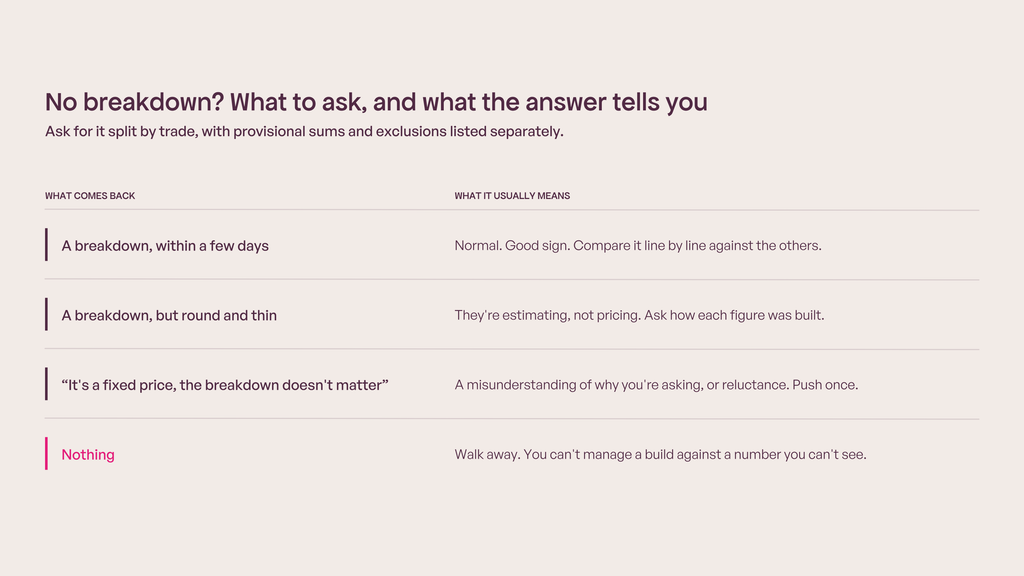
Something like this works: “Thanks for this. Before I compare it properly, could you send it split by trade, with any provisional sums and exclusions listed separately? I’m asking all three builders for the same thing so I’m comparing like for like.”
That last sentence does the work. It frames the request as process rather than suspicion, and it’s true. What comes back tells you what you’re dealing with.
The real fix: price the same scope, not the same brief
The cause is that most homeowners send builders a description of the job rather than a specification of it. Each builder fills the gaps differently, prices their own version, and returns a number that can’t be compared with anyone else’s.
We solve this before quotes are requested. Every project is scoped into a Schedule of Works: a written, itemised description of every element of the job, produced independently of the builders. Each builder then prices that same document. The result is a set of quotes that differ only on price and approach, not on what’s included, which is what makes a section-by-section comparison, and an adjusted total, possible at all.
FAQs
Is a quote without a breakdown legally binding?
Yes, if it’s genuinely a quote rather than an estimate. Once you accept a quote, the builder is committed to doing that work for that price. The difficulty is that “that work” is undefined, which is where the arguments start.
What’s the difference between a quote and an estimate?
An estimate is an informed guess and can change. A quote is a firm offer that becomes binding on acceptance, as LABC Front Door explains. Check which one you’re holding.
Should the breakdown show labour and materials separately?
It’s useful but not essential, and many builders won’t split it because it exposes their margin. A trade-by-trade split with clear provisional sums and exclusions is more valuable for comparison than a labour/materials divide.
Does a builder’s quote include VAT?
It should say either way. Most renovation work is charged at the standard 20% rate. Some projects qualify for the reduced 5% rate, including conversions that change the number of dwellings and homes empty for two years or more, under HMRC’s VAT Notice 708. A quote that doesn’t state its VAT position is incomplete.
How many builders should I ask to quote?
Three to five is the usual advice, and the FMB recommends detailed written quotes from at least three. More than five rarely improves the outcome and makes the process harder to run. All of them must be pricing the same scope, though, or the extra quotes add noise rather than information.
What if the quote has a breakdown but I still can’t compare it?
The fix is to ask for the same items grouped the same way, or to give both builders a schedule that decides the grouping for them.
What if I’ve already signed a quote with no breakdown?
Ask for one now, before work starts, and agree it in writing as the basis for valuing stage payments and variations. Most builders will cooperate. If the job is large enough, a formal contract such as a JCT home owner contract gives both sides a proper framework for changes, retention and delay.
Read next
- How to read a builder’s quote, and why most homeowners struggle with this
- Why accurate and comparable builders’ quotes are so important
- Everything you need to know about the tender process
- How do I know when a builder is good, and not just friendly or well priced?
- How to set a renovation budget you can actually work with
- How do I protect myself from a renovation going over budget and over time?
At The Page we scope projects, run competitive tenders with vetted builders, and manage the build from first call to final snag. See how it works.
Tags
Renovate the savvy way
- Simplified process with support throughout
- Pay the right price for proven Pagers
- Transparent pricing & timelines
SHARE THIS ARTICLE