Back to blog
Should the bathroom suite be a PC sum?
A PC sum covers goods only. The labour to fit them, the builder’s attendance and his profit are all priced on top.
Yes, if you haven’t chosen it. A prime cost sum is the right way to price a bathroom suite you haven’t picked, because it forces every builder to allow the same money for the same items and keeps your quotes comparable while you’re still shopping.
Use a fixed price instead once you’ve chosen. And use a provisional sum for the work you haven’t designed, not for the goods you haven’t bought. Those are two different problems with two different instruments, and quotes that muddle them are the ones that come apart later.
A PC sum covers goods only. The labour to fit them, the builder’s attendance and his profit are all priced on top.
Most of the trouble we see starts with a homeowner reading a £2,800 bathroom allowance as the cost of the bathroom. The instrument is easy. The item list behind it is where the money is, and that’s what the rest of this covers.
What a prime cost sum actually is
A prime cost sum is an allowance in a builder’s quote for the supply of goods you haven’t selected yet. Sanitaryware, tiles, brassware, ironmongery. The builder prices everything around it and holds the goods at a stated figure until you make your choice, then the figure is adjusted up or down against the real invoice.
Under the industry standard, RICS New Rules of Measurement 2, a PC sum is a sum of money to be spent on materials or goods from suppliers where the precise quality isn’t yet known; it is supply only. The exclusion list covers fixing and installation, ancillary and sundry materials, design fees, preliminaries, overheads and profit. In practice the builder’s attendance, meaning taking the delivery, storing it, providing access and clearing the waste, sits outside the sum too.
That exclusion list is not a technicality. It’s most of the money.
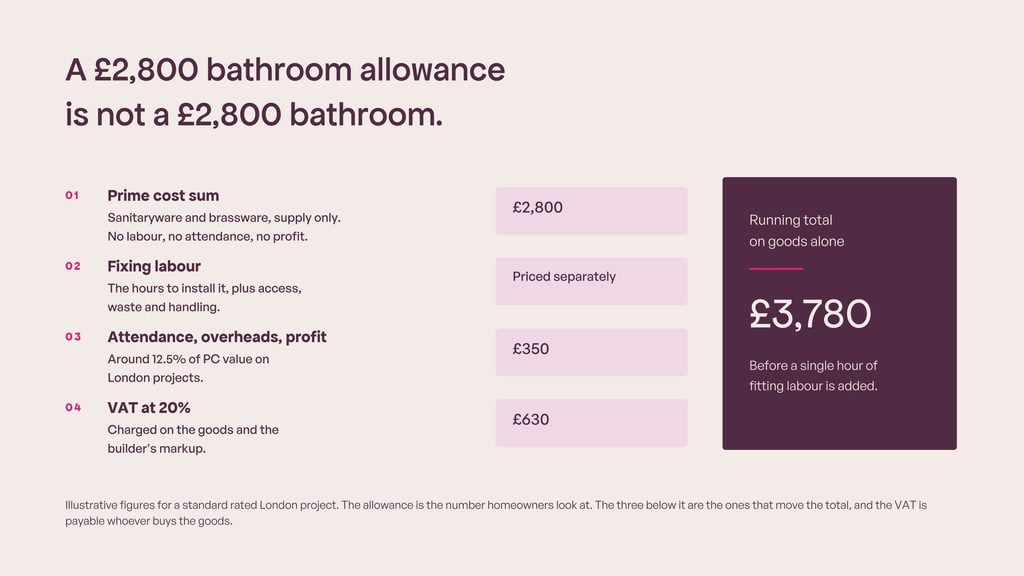
Our own guidance on what a prime cost sum is and how much to allow puts attendance and profit at around 12.5% of PC value on London projects. On a £2,800 allowance that’s £350 before VAT. Worth knowing and worth asking about, but not worth arguing over. It is a real cost to the builder.
The VAT in that build-up is payable whoever buys the goods, so it isn’t a reason to keep the suite out of the builder’s price. The 12.5% is the only part that comes with the PC route, and the fitting labour is a cost you’d carry either way.
PC sum or provisional sum? They are not interchangeable
Plenty of quotes get this wrong, and it’s an easy one to check.
- A PC sum is for goods you haven’t chosen.
- The design is settled, the item is understood, you just haven’t picked the model. A bath, a basin, a WC, a shower valve, tiles.
- A provisional sum is for work that hasn’t been designed or can’t yet be seen.
- Moving a soil stack when nobody knows where it runs. Repairing joists that are still under a floor. Re-routing pipework behind a wall that hasn’t been opened up.
If the uncertainty is about what you’ll buy: it’s a PC sum. If the uncertainty is about what needs doing: it’s a provisional sum.
Bathrooms generate both, which is why they’re the room where the two get muddled. A typical London bathroom quote should carry a PC sum for the suite and separate provisional sums for anything structural or hidden. If your quote holds the whole bathroom as one provisional sum, you don’t have a price. You have a placeholder. There’s more on the second instrument in what is a provisional sum.
What allowance should you set for a bathroom suite?
For a standard London bathroom, £2,200 to £3,500 per room is a realistic PC sum for sanitaryware. Supply only, excluding VAT, excluding tiles, excluding fitting.
That range buys a decent mid market suite. It does not buy a designer brassware set, a stone resin bath or a wall hung WC with a concealed frame from a European designer brand. If that’s the direction you’re heading, set the allowance where you’re actually shopping, not where it feels comfortable.
Tiles sit separately, usually £25 to £60 per square metre supply only in London, and a small bathroom eats more square metres than people expect once you tile floor to ceiling and account for cuts and wastage.
Set the allowance at what you intend to spend, not at what makes the quote look good. An allowance you already know you’ll exceed isn’t a budget. It’s an overspend you’ve agreed to have later.
What does a bathroom suite actually include?
Ask three builders to allow a PC sum for a bathroom suite and you’ll get three different item lists behind the same phrase.
To one builder, a suite is a bath, a basin and a WC. To another it includes the brassware. To a third it includes the shower enclosure. None of them is wrong, because nobody told them.
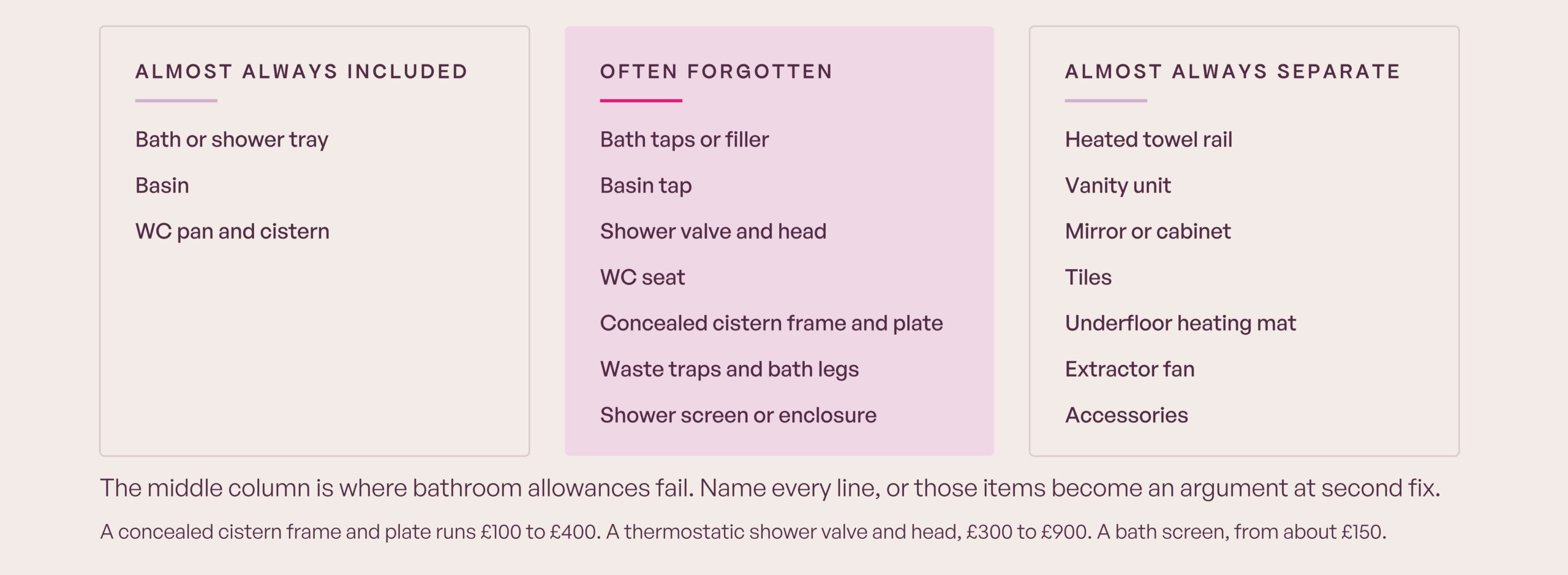
The items in that middle column are where bathroom PC sums fail. A concealed cistern frame and flush plate runs from around £100 to £400. A thermostatic shower valve and head, £300 to £900. A bath screen from about £150, and a walk in enclosure considerably more. Add three or four of those to an allowance that was only ever meant to cover a bath, basin and WC and you’re £800 to £1,500 over before you’ve chosen a tile.
The fix takes ten minutes. Write the item list into the schedule of works, line by line, and give the identical list to every builder.
Why this makes or breaks quote comparison
Bathrooms are a reliable source of of why quotes have a spread. One builder allows £2,500 for the suite, another writes “sanitaryware by others” and prices labour only, and a third allows £5,000 because he’s seen the interior designer’s board. Three totals, three different projects, and the cheapest one is cheapest because it contains the least.
A quote is only comparable when every builder has priced the same allowance for the same list of items.
That’s the entire argument for using a PC sum rather than leaving it out or letting each builder guess. The point is not to pin down the cost. It’s to remove one variable so the difference between two totals means something. The same pattern shows up across why two builders price the same bathroom differently and it’s a large part of why the cheapest quote is usually the most expensive in the end.

The VAT point that is specific to bathrooms
Most renovations are standard rated at 20% and VAT changes nothing about this decision. But some residential work qualifies for a reduced 5% rate, most commonly where a property has been empty for two years or more, or where you’re changing the number of dwellings. The rules are in HMRC’s VAT Notice 708, and section 2.2 is the one that matters: builders charge VAT on the materials they supply and install at the same rate as their work.
So on a qualifying project, a suite the builder supplies under a PC sum carries 5% VAT. The same suite bought by you carries 20% at the retailer, with nothing to reclaim.
Baths, basins, WCs and showers are building materials, so they take the reduced rate when the builder supplies and installs them. Bathroom furniture, past a certain point, does not. HMRC’s guidance on vanity units draws the line by function. A simple unit whose purpose is to support the basin and hide the pipework counts as a building material. But “more elaborate vanity units, typically with other storage space constructed on either or both sides of the basin, are furniture, as are wall units such as bathroom cabinets”, and furniture other than kitchen furniture is excluded from building materials altogether.
The practical effect on a 5% project: the bath, basin, WC and shower go in the builder’s PC sum at 5%, while the run of fitted storage along the wall and the mirrored cabinet stay at 20%. And it isn’t only the goods. Section 7.1.1 of Notice 708 is clear that where a builder installs something that isn’t a building material, the installation charge is standard rated too, so the labour to fit that vanity unit carries 20% as well.
Split them into separate lines in the schedule so your builder can charge the right rate on each, and so you can see what you’re actually paying.
The adjustment almost nobody does
A PC sum is provisional by design. When the goods are bought, the sum is supposed to be adjusted against the actual supplier invoice, up or down, in the final account.
In practice the downward adjustment is the one that gets forgotten. If you allowed £3,000 and spent £2,400, that £600 is yours. If you allowed £3,000 and spent £3,900, the £900 is the builder’s to claim, and he will, plus his percentage on the increase and VAT on both. On the 12.5% figure above, that £900 overspend reaches you as roughly £1,215.
Ask for the invoice. Not to catch anyone out, but because that’s how the mechanism works. A good builder produces it without being asked and shows you the trade price and the markup separately. If the trade discount is being kept rather than passed on, that’s a fair thing to raise, and it’s a much easier conversation at the start than at the end.
Keep the invoices as they come in rather than asking for them all at the end. An allowance you can evidence is an allowance you can argue about calmly. One you can’t is a number two people remember differently.
When you shouldn’t use a PC sum
Three situations where a PC sum is the wrong instrument.
- You’ve already chosen. If the suite is specified, name the products with model numbers and get a fixed price. A PC sum on a decided item is just uncertainty you’ve invented.
- You’re buying it yourself. Then it isn’t a PC sum at all. It’s a client supplied item and the builder’s price should cover the fitting and nothing else. That comes with its own set of consequences around delivery risk, storage and who’s liable for a chipped bath, and we’ve been through those in detail in should the kitchen units be in the builder’s price. The logic transfers directly.
- The uncertainty is about the work, not the goods. Use a provisional sum, and make sure it’s a defined one with a scope attached rather than a number floating on its own.
What to settle before anyone quotes
Seven things to agree in writing before a single builder prices the bathroom.
- Exactly which items the suite allowance covers, listed line by line, including brassware, the shower valve, the WC seat, the cistern frame and any screen or enclosure.
- What the allowance is, set against what you’re actually shopping for.
- Whether tiles are inside the allowance or held as their own PC sum per square metre.
- Whether the vanity unit, mirror, cabinet and towel rail are in the builder’s price or yours.
- What percentage the builder adds for attendance, overheads and profit on PC value.
- Whether the project is standard rated or reduced rated for VAT, and which items qualify.
- That the PC sum will be adjusted against actual invoices in the final account, in both directions.
Number one is the one to be firm about. Almost every bathroom allowance dispute we see traces back to an item list nobody wrote down.
Common questions
Should the bathroom suite be a PC sum or a provisional sum? A PC sum, if you haven’t chosen it. PC sums are for goods you haven’t selected. Provisional sums are for work that hasn’t been designed or can’t yet be seen, such as moving a soil stack or repairing joists you haven’t uncovered. A bathroom quote often needs both, held as separate lines.
Does a PC sum include fitting? No. Under NRM2 a PC sum is supply only. It excludes fixing and installation, ancillary materials, design fees, preliminaries, overheads and profit, and the builder’s attendance sits outside it too. Those are priced separately, and on London projects the attendance and profit element typically runs at around 12.5% of PC value.
How much should I allow for a bathroom suite in London? £2,200 to £3,500 per room for sanitaryware, supply only and excluding VAT, is realistic for a mid market suite. Tiles sit separately at roughly £25 to £60 per square metre supply only. If you’re shopping above that range, say so at tender rather than at the final account.
What happens if I spend more than the PC sum? The difference is added to the final account and you pay it, plus the builder’s percentage on the increase and VAT on both. A £900 overspend at 12.5% and 20% reaches you as roughly £1,215. If you spend less, the sum should be adjusted down and the saving is yours. Ask to see the supplier invoice either way.
Does the builder mark up a PC sum? Yes, and reasonably so. He’s funding the purchase before you’ve paid him, taking the delivery, storing it and standing behind it. Ask what the percentage is and whether any trade discount is passed on. It’s a fair question and a good builder will answer it.
Should tiles be a PC sum too? Usually, and priced per square metre rather than as a lump. Tiles vary more in price than almost anything else in a bathroom, and a rate per square metre lets every builder price the same quantity while you keep choosing.
Can I supply the bathroom myself instead? You can, and on a standard rated project you’ll save the builder’s markup. You also take on the delivery risk, the storage, the replacements and the programme. On a project that qualifies for 5% VAT it’s usually the wrong call, because the reduced rate only applies to what the builder supplies and installs.
Should the shower screen be in the suite allowance? Only if you say so. It’s one of the most commonly excluded items, along with the shower valve, the WC seat and the concealed cistern frame. Write the item list out rather than relying on the word “suite”.
Tags
Renovate the savvy way
- Simplified process with support throughout
- Pay the right price for proven Pagers
- Transparent pricing & timelines
SHARE THIS ARTICLE